
Category: Real Estate Guides

  • Indian Real Estate Market Trends in 2026: What Actually Matters When You’re Buying

    Indian Real Estate Market Trends in 2026: What Actually Matters When You’re Buying

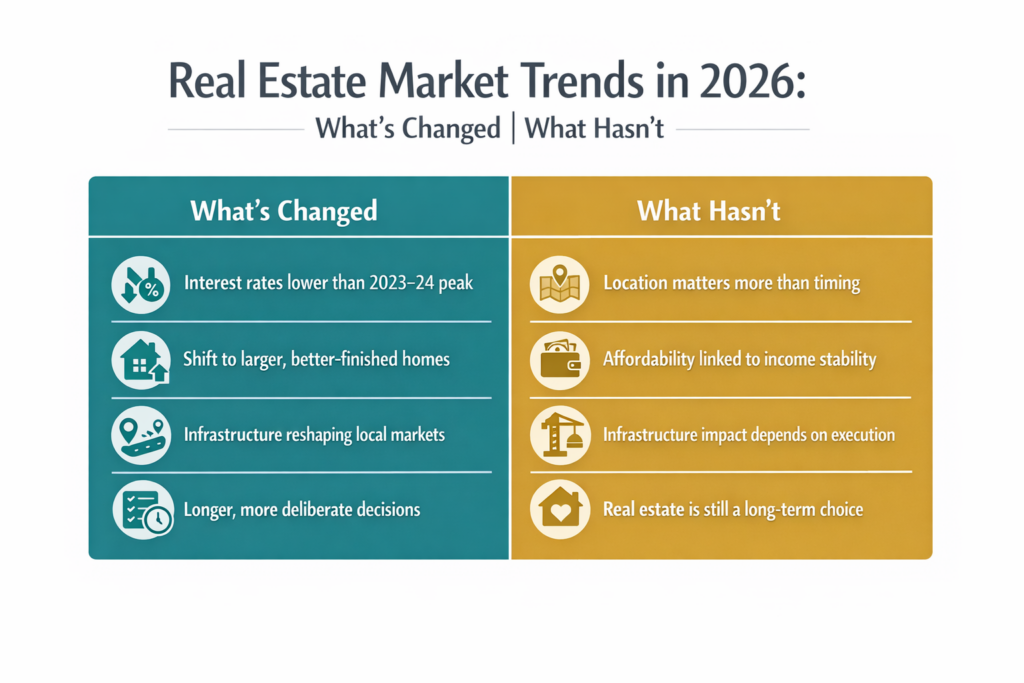
    The Indian real estate market trends in 2026 look very different from earlier cycles. There is less urgency and far fewer rushed decisions. Homebuyers are spending more time evaluating location, construction quality, and long-term comfort, rather than worrying only about short-term price movements.

    This blog outlines the key real estate market trends shaping India in 2026, so you can decide with context rather than noise.
    real-estate-market-trends-2026

    A Supportive Economic Backdrop Without Euphoria

    India enters 2026 with a relatively stable economic environment compared to many other major economies. Growth expectations remain steady, private consumption supports demand, and inflationary pressures have eased from earlier highs.

    For homebuyers, this stability mainly reduces uncertainty. While it does not guarantee returns, it makes it easier to plan long-term purchases like a home. Compared to earlier cycles shaped by sudden policy shifts or demand shocks, the current phase is slower and more measured, giving buyers time to compare options and decide thoughtfully.

    What this means for your home-buying journey:

    • More predictable EMIs: Reduced volatility in interest rates makes loan planning more stable.
    • Less urgency: Buyers can evaluate locations and projects without pressure to rush.
    • Some budget flexibility: Moderating price pressures may make monthly commitments easier to manage for some households.

    For those tracking real estate market trends, this backdrop signals lower macro risk rather than automatic opportunity. The value lies in clearer decision-making, not guaranteed outcomes.

    Interest Rates and Housing Affordability in 2026

    One of the most closely watched real estate market trends in 2026 is housing affordability in India, and how interest rates affect monthly EMIs.

    After a prolonged period of higher borrowing costs, the Reserve Bank of India reduced policy rates through 2025. As a result, home loan EMIs are lower than their earlier peak levels, easing some of the pressure on household budgets. By early 2026, monetary policy has moved into a wait-and-watch phase, allowing the impact of previous rate reductions to flow through the system.

    For homebuyers, lower borrowing costs can improve affordability at the margin, especially in mid-range and premium housing segments. However, interest rates alone are not a reason to rush into a purchase.

    In the current cycle, the more important question is not, “Are interest rates low?” It is, “Does this home remain affordable if rates stay where they are today?”

    Practical considerations for buyers:

    • Plan for stability, not further cuts: Treat current EMIs as a baseline rather than assuming future reductions.
    • Build in a margin of safety: Before finalising a loan, it helps to check whether your monthly budget remains comfortable if rates were to rise modestly in the future.
    • Focus on long-term affordability: A home that fits comfortably into your finances today is more likely to remain manageable over the life of the loan.

    Seen in this light, interest rates in 2026 support planning and clarity rather than urgency, aligning with a more deliberate phase in real estate market trends.

    Why Premium Homes Lead the 2026 Real Estate Trends

    One of the clearest real estate market trends in recent years is the gradual premiumisation of housing demand.

    Across major cities, developers are increasingly focused on higher-value homes, while supply in lower price segments has tightened. This shift is shaped by rising land prices, higher construction costs, and stricter compliance norms, which have made smaller-ticket projects harder to execute.

    In 2026, “premium” is less about visible luxury and more about how a home supports everyday living. Buyers are prioritising usable space, work flexibility, lower crowding, and execution reliability over decorative upgrades.

    What defines a “Premium” home in 2026?

    • Dedicated work-ready spaces that support hybrid routines
    • Lower-density developments with fewer homes per acre
    • Wellness and sustainability features that are increasingly expected
    • Reliable execution, with delivery track record carrying more weight than branding

    How standards have evolved

    Feature 2022 Lifestyle 2026 Premium Standard
    Work Working from the dining table Dedicated home office with soundproofing
    Parking Standard basement parking EV-ready slots with smart monitoring
    Density 500+ units in a small cluster Low-unit counts with private lift lobbies
    Amenities Basic gym & pool Wellness spas & boutique fitness studios

    Infrastructure: The “20-Minute City” Narrative

    In 2026, buyers have moved beyond simply choosing homes that are “near a highway” or “close to a metro line.” Infrastructure continues to influence real estate market trends, but its impact is no longer uniform across locations.

    What matters now is whether infrastructure actually makes daily life easier. Proximity on a map does not always translate into real connectivity on the ground.

    How to identify infrastructure-led locations that tend to perform better:

    • Walkable access matters
    • Last-mile quality is critical
    • Peripheral locations with real connectivity

    For buyers, the takeaway is to focus on micro-markets rather than city-wide announcements. Infrastructure creates opportunity only where it translates into practical, everyday connectivity.

    Pune as a Lens on India’s Real Estate Market Trends

    Pune offers a useful lens for understanding how real estate market trends play out in a city driven largely by end-user demand.

    Key takeaways from Pune’s market:

    • Demand follows employment
    • The upgrade buyer effect
    • East versus West dynamics

    What buyers can learn from this:

    • Look for active communities
    • Prioritise resilience over spikes

    Technology, Transparency, and Changing Buyer Behaviour

    Another important real estate market trend is the gradual improvement in transparency.

    Technology is making decisions easier, but it is not removing complexity.

    Emerging Real Estate Market Trends to Watch

    • Senior living
    • Flexible workspaces
    • Data centres and digital infrastructure

    What Real Estate Market Trends in 2026 Mean for Buyers

    India’s real estate market trends in 2026 point to a clear shift in behaviour.

    The focus has moved away from speculation and toward planning.

    That shift is the most important real estate market trend of 2026.

     

  • Rent vs Buy: Which Housing Decision Makes More Sense in 2026?

    Rent vs Buy: Which Housing Decision Makes More Sense in 2026?

    The rent vs buy question has become more complex in 2026. Rising home prices, rental inflation, and changing work patterns mean that renting vs buying is no longer a simple financial comparison.

    Instead of asking “Is it better to rent or buy a house?”, the real question is which option aligns with your costs, risk appetite, and time horizon.

    Renting vs Buying in 2026: What’s Different Now?

    The housing market in 2026 looks very different from a few years ago.

    Key Real Estate Trends Affecting Rent vs Buy Decisions in 2026

    Housing affordability remains stretched in most cities, while rental inflation continues to rise across metros and IT hubs. At the same time, price appreciation varies sharply by micro-market, and market volatility makes long-term assumptions increasingly risky.

    Because of this, renting is no longer a temporary compromise, and buying is no longer an automatic wealth move.

    Cost of Renting vs Buying a House

    A fair rent vs buy cost comparison starts by understanding all expenses, not just rent and EMI.

    Costs Involved in Renting

    • Monthly rent
    • Security deposit
    • Annual rent escalation
    • Minor maintenance

    Renting has lower upfront costs and offers short-term flexibility, but does not build equity.

    Costs Involved in Buying

    Buying a home includes multiple cost layers:

    Upfront

    • Down payment
    • Stamp duty and registration

    Ongoing

    • Home loan EMI
    • Mortgage interest
    • Maintenance costs
    • Property tax
    • Insurance cost

    This is why a simple rent vs mortgage cost comparison often hides the real picture.

    Monthly Rent vs Home Loan EMI: Not the Right Benchmark

    A common argument for buying is: “My EMI is almost equal to my rent.”

    But EMIs include a large interest component, especially in the early years.

    Rent, on the other hand, is a fixed expense that buys flexibility.

    So the real question is not monthly rent vs home loan EMI, but:

    What does each option lock you into over the long term?

    Renting vs Buying: Risk, Value, and Equity

    Buying a Home: Equity Building and Ownership

    Pros:

    • Gradual equity building
    • Long-term asset ownership
    • Potential wealth creation through appreciation

    Cons:

    • High financial risk if income changes
    • Capital locked in down payment
    • Exposure to market volatility

    Buying works best with a long holding period and stable income.

    Renting a Home: Flexibility and Lower Risk

    Pros:

    • Short-term flexibility
    • Lower upfront cost
    • Easier relocation

    Cons:

    • No equity or ownership
    • Impact of rental inflation

    In many cases, renting preserves capital that could be used elsewhere – highlighting the opportunity cost of buying a home.

    Rent vs Buy Break-Even Point: When Does Buying Win?

    One of the most searched questions is: When does buying beat renting?

    The answer depends on:

    • Property price
    • Down payment amount
    • Home loan EMI and interest rate
    • Rent growth
    • Expected future value

    Typical Break-Even Period in India

    In most Indian cities, buying usually beats renting after 7–10 years. Shorter stays tend to favour renting, while longer holding periods reduce buying risk.

    If you are evaluating the rent vs buy break-even point or asking how long to stay to make buying worth it, the time horizon becomes the deciding factor.

    Rent or Buy House: Time Horizon Matters Most

    Short-Term (0–5 Years)

    Renting is usually better due to:

    • Lower commitment
    • Minimal transaction costs
    • Greater flexibility

    Medium-Term (5–8 Years)

    This is a grey zone where:

    • Location matters a lot
    • Price appreciation assumptions carry risk

    Long-Term (8+ Years)

    Buying starts making sense because:

    • EMI interest impact reduces
    • Equity accumulates
    • Housing costs stabilize

    The renting vs buying long-term cost comparison only works with realistic timelines.

    Rent vs Buy House in India: Context Is Everything

    The rent vs buy property decision in India is shaped by:

    • Job mobility
    • Family expectations
    • City-level affordability
    • Local rental and price trends

    Renting vs Buying in India Makes Sense When:

    • You rent in high-cost cities with uncertain appreciation
    • You buy in areas with stable demand and infrastructure growth

    There is no universal answer to whether you should buy or rent in India – it is always location-specific.

    Should You Rent or Buy a House in 2026?

    Instead of looking for a generic rule, ask these questions:

    • How long will I realistically stay here?
    • Can I manage a long-term financial commitment?
    • What is the opportunity cost of my down payment?
    • Does this purchase improve long-term affordability?
    • Am I buying stability or stretching my finances?

    This reframes the rent or buy house decision from emotion to planning.

    Renting vs Buying: Which Is Better in 2026?

    In 2026, the answer depends on alignment, not trends.

    • Rent if you value flexibility, liquidity, and lower risk
    • Buy if you value stability, equity building, and long-term certainty

    Ultimately, the smartest decision to rent or buy a home is the one that fits your time horizon, income stability, and future plans.

    Before committing, step back, compare, and decide, because housing choices should be intentional, not rushed.

    That’s exactly how TryThat.ai helps you plan before you commit.

    FAQs: Rent vs Buy in 2026

    Should I rent or buy a house in 2026?

    You should rent if you need short-term flexibility or expect location or income changes in the next few years. Buying makes more sense in 2026 if you have a stable income, can afford the down payment comfortably, and plan to stay long term.

    Is it better to rent or buy a house in India?

    There is no single answer across India. Renting often works better in high-cost cities with uncertain price appreciation, while buying can make sense in areas with stable demand, improving infrastructure, and long holding periods.

    What is the cost of renting vs buying a house?

    Renting involves monthly rent, a security deposit, and rent escalation. Buying includes a down payment, home loan EMI, mortgage interest, maintenance costs, property tax, and insurance. Comparing only rent and EMI does not show the full cost difference.

    When does buying beat renting?

    Buying typically beats renting after the rent vs buy break-even point, which is usually around 7–10 years in Indian cities. Shorter stays favour renting, while longer holding periods reduce buying risk.

    How long should I stay to make buying a house worth it?

    In most cases, you need to stay at least 7–8 years to offset interest, transaction costs, and market volatility. If your stay is shorter, renting is usually the safer financial choice.

    Renting vs buying, which is better for the long term?

    Buying can support long-term equity building and asset ownership, but it also carries financial risk and opportunity cost. Renting offers flexibility and liquidity, which can be more valuable depending on your future plans.

  • Proptech Solutions Explained: Real-World Use Cases in Modern Real Estate

    Proptech Solutions Explained: Real-World Use Cases in Modern Real Estate

    Like most industries, real estate is becoming increasingly digital. Yet, many real estate processes still rely on fragmented systems and manual coordination behind the scenes.

    Proptech solutions aim to bridge this gap, making real estate workflows more seamless by applying technology across different parts of the real estate lifecycle. The result is improved visibility and support for better decision-making across buying, selling, and property management.

    What are Proptech Solutions?

    Proptech solutions refer to technology-driven tools and platforms designed to improve how real estate is marketed, evaluated, transacted, and managed. These solutions use software, data analytics, automation, and AI to reduce manual effort and increase transparency across real estate processes.
    In short, proptech solutions use technology to simplify how people discover, evaluate, buy, and manage property.

    Types of Proptech Solutions Across the Real Estate Lifecycle

    Proptech is not a single tool or platform. It covers a wide range of technology solutions for the different stages of the real estate lifecycle. Each category addresses a specific operational or decision-making challenge.

    1. Discovery and Search Platforms

    These solutions focus on how buyers discover properties.
    They improve:

    • Property search accuracy
    • Filtering based on budget, location, and preferences
    • Access to verified listings and data

    Instead of browsing hundreds of irrelevant listings, users receive more structured and relevant property options. This reduces search fatigue and improves early-stage decision clarity.

    2. Property Evaluation and Analytics Tools

    This category helps users evaluate whether a property makes sense financially and strategically.

    These solutions analyze:

    • Historical pricing data
    • Location-level demand trends
    • Comparable property performance
    • Market activity and liquidity

    They help buyers move beyond surface-level pricing and understand how a property is positioned within its local market.

    3. Marketing and Lead Management Solutions

    These proptech tools are commonly used on the seller side of the market, including developers and channel partners.

    They support:

    • Digital property marketing
    • Lead tracking and follow-ups
    • Campaign performance measurement

    Automation in this stage reduces manual effort and improves response times, which is critical in competitive markets.

    4. Transaction and Documentation Platforms

    Transaction-focused proptech solutions aim to simplify complex paperwork and coordination.

    They assist with:

    • Digital documentation
    • Online booking and payments
    • Process tracking across approvals and agreements

    This improves transparency and reduces friction during one of the most stressful parts of the real estate journey.

    5. Property and Facility Management Systems

    These solutions operate post-purchase or post-lease.

    They help manage:

    • Rent collection and maintenance
    • Tenant communication
    • Asset performance tracking

    For homeowners and property managers, this brings structure and efficiency to ongoing property management.

    Real-World Use Cases of Proptech Solutions in Modern Real Estate

    Here’s how this actually plays out in real situations.

    1. Smarter Property Discovery for Homebuyers

    Proptech platforms improve how buyers search for properties by organizing listings using structured data instead of simple keyword filters.

    These solutions help by:

    • Matching properties based on budget, location preferences, and lifestyle needs
    • Reducing duplicate or outdated listings
    • Highlighting properties that align with buyer intent
    • Leads to faster discovery (especially in markets with high inventory volume)

    Data-Backed Property Evaluation

    One of the biggest advantages of proptech solutions is their ability to support better evaluation before purchase.

    Using market data and analytics, you can:

    • Compare prices with similar properties in the same micro-location
    • Identify demand patterns for specific neighborhoods
    • Highlight pricing inconsistencies or potential overvaluation

    Digital Marketing and Lead Handling

    For developers and sellers, proptech solutions simplify how properties are marketed and enquiries are managed.

    Common use cases include:

    • Automated lead capture and routing
    • Tracking enquiry sources and response times
    • Measuring performance of digital campaigns

    This ensures faster follow-ups and improves conversion efficiency without increasing manual workload.

    4. Streamlined Transactions and Documentation

    Proptech platforms also reduce friction during the transaction stage.

    They support:

    • Digital booking and payment processes
    • Centralized document storage and sharing
    • Status tracking across approvals and agreements

    This brings transparency and structure to a process that is traditionally paperwork-heavy and time-consuming.

    5. Ongoing Property Management and Operations

    After purchase or leasing, proptech solutions help manage properties more efficiently.

    They are commonly used for:

    • Maintenance request tracking
    • Rent and fee collection
    • Communication between owners, tenants, and service providers

    This improves operational visibility and reduces dependency on manual coordination.


    What Changes When Proptech Solutions Are Applied


    Here’s how Proptech solutions can help make the whole decision-making process more structured:

    • More informed decision-making:
      Property pricing, demand signals, and market comparisons become easier to evaluate when data is presented in a structured and comparable format.
    • Reduced dependency on manual follow-ups:
      Automated workflows reduce delays caused by human coordination, improving speed across property discovery, documentation, and communication.
    • Greater consistency in information:
      Listings, pricing benchmarks, and property details remain standardized across platforms, reducing discrepancies and confusion.
    • Early visibility into risks and inefficiencies:
      Proptech tools surface issues such as pricing mismatches, demand drop-offs, or inventory saturation earlier in the process.

    How to Get the Most Out of Proptech Solutions

    Proptech solutions make the homebuying journey more structured and transparent, but they are not meant to replace human judgment entirely. Their accuracy depends on the quality and freshness of the data they use.
    Insights may need to be reviewed in addition to local knowledge or professional advice, especially in areas where the market data is outdated or inconsistent.
    That’s primarily why proptech solutions work best as an extension for your decision-making process. When you combine it with on-site visits, expert input, and personal priorities, you can:

    • Reduce uncertainty
    • Avoid costly mistakes
    • Make more confident decisions

    How Proptech Solutions Are Evolving

    We are looking at a proptech future that is smarter, more connected, and more focused on buyers.

    At Trythat platform, property discovery, evaluation, and decision support come together in one place, reducing the need to rely on multiple tools. With verified listings and structured data, buyers can better understand pricing trends, demand patterns, and potential risks before making decisions.
    AI in proptech works best as a decision-support layer, not a replacement for human judgment. It helps surface relevant insights faster, while buyers continue to rely on site visits, local context, and personal priorities.
    Overall, proptech solutions are evolving to make property discovery, evaluation, and management more efficient, transparent, and accessible for homebuyers.

  • Buying a Flat in Pune? Here’s How to Check If It’s Worth the Price in 2025

    Buying a Flat in Pune? Here’s How to Check If It’s Worth the Price in 2025

    Pune has been one of India’s most resilient real estate markets, appreciating steadily.
    In 2025, prices across key localities in Pune continue to rise, driven by strong demand from professionals, families, and investors. Areas of Pune, such as Baner, Kharadi, and Wakad, have witnessed an annual increase of 8-12%.

    But since growth is not uniform across Pune, not all properties are worth your money. The best way to know if a flat in Pune is worth its price is to evaluate its ROI potential, demand level, and risk profile before booking.

    Why Traditional Property Research Isn’t Enough

    Many buyers rely on portals, agent recommendations, or simple price lists- which tell you how much a property costs but not whether it’s worth that price.

    Consider this:

    • Properties in premium areas like Koregaon Park or Viman Nagar can command ₹12,000+ per sq. ft because of lifestyle value and centrality.
    • Emerging localities like Punawale or Tathawade remain below ₹8,000 per sq. ft despite strong future potential.
    • Peripheral zones like Pimpri-Chinchwad can offer even lower entry points

    When comparing ROI and long-term growth, these are the differences that matter.

    3 Scores Every Buyer Should Check Before Buying a Flat in Pune

    #1 ROI (Return on Investment)

    ROI indicates the financial return you can expect from a property over time, including resale gains and rental yield.

    What Pune data shows:

    Localities near IT and commercial hubs offer stronger capital appreciation.

    For example:
    • Kharadi: Prices forecast to rise from ₹9,500–₹10,200 per sq. ft in 2024 to ₹10,200–₹11,000 in 2025.
    • Wakad: Expected price increase from ~₹7,200 in 2024 to ₹7,800–₹8,500 in 2025.
    • Baner: Forecast to rise from ~₹10,500 to ₹11,500–₹12,500 per sq. ft.

    Emerging and peripheral areas show mixed performance. However, these areas hold upside potential if infrastructure improves.

    Why this matters:

    A flat in Kharadi or Baner might cost more initially, but can deliver stronger capital gains if the neighborhood demand remains robust.

    #2 Demand Score

    Demand score reflects real market interest from buyers and renters, not just what an agent claims.

    Key demand drivers in Pune:

    • IT Sector Growth: Pune’s rapid transformation, with expanding office space and strong hiring, continues to attract professionals while lifting housing demand.
    • Metro and connectivity improvements: New and ongoing Metro projects have boosted demand around connected corridors such as Hinjewadi, Baner, and Wakad.
    • High transaction levels: Pune logged a 4-year high in property registrations in 2025, indicating active buyer interest across segments.

    How this helps you:

    A high Demand Score signals better resale prospects and rental occupancy. This is especially useful if you’re buying for investment or future mobility.

    #3 Risk Profile

    Risk measures uncertainties and potential downsides. This includes supply oversaturation, project delays, legal issues, or price volatility.

    In Pune today:

    • Some affordable housing zones currently face infrastructure gaps, which can slow demand.
    • Luxury segments have continued to outperform in terms of revenue, even where overall unit sales are slow, indicating a structural preference among buyers for premium space.
    • Central and IT-linked suburbs still maintain strong pricing power, but rapid growth cycles can sometimes overshoot if supply grows faster than demand.

    Why this matters:

    A high risk score suggests you could face slower growth or resale challenges, which is especially relevant in fringe submarkets or speculative launches.

    Pune’s Key Markets in 2025

    Hinjewadi:

    • A major IT employment centre with ongoing infrastructure development
    • Historically strong rental demand due to working professionals
    • Prices in broader Hinjewadi often range between ₹5,000–₹8,500 per sq. ft, making it comparatively affordable.

    Best for: Investors targeting steady rental income and long-term capital gains.

    Kharadi:

    • One of the fastest-growing residential markets, supported by office hubs and excellent connectivity.
    • Expected consistent price growth and strong interest from end-users and investors

    Best for: Balanced ROI + demand profile.

    Baner:

    • Premium locality with lifestyle facilities and excellent connectivity
    • Price forecast shows strong appreciation potential

    Best for: Long-term investors and families seeking lifestyle benefits.

    Wakad and Pimpri-Chinchwad

    • Growing suburbs offering comparatively affordable options and strong future upside
    • Wakad’s proximity to Hinjewadi boosts demand

    Best for: First-time buyers and budget-conscious investors

    How to Compare Two Properties in Pune Using These Scores

    • ✅Evaluate ROI potential: Which property shows stronger expected appreciation?
    • ✅Look at Demand Score: Which location attracts more buyers and tenants?
    • ✅Check the Risk Profile: Is one property more vulnerable to delays or market swings?

    This same ROI-Demand-Risk framework can be applied instantly using Trythat, helping you make confident decisions in minutes instead of weeks.

    Conclusion

    Pune’s real estate market is growing, but prices and demand vary widely across localities. By checking ROI, demand, and risk before booking, you ensure you are paying for the value and not hype.

    Ready to evaluate your shortlisted flats in Pune more confidently?
    Log in to Trythat today and get instant, data-backed scores that help you decide in seconds.

    FAQs

    1. Is Pune real estate a good investment in 2025?

    Yes. Key areas like Baner, Kharadi, and Wakad are seeing around 8–12% annual appreciation driven by IT growth and new Metro connectivity.

    2. Which areas in Pune offer the best ROI?

    Kharadi and Baner lead for capital gains, while Hinjewadi remains a top choice for steady rental income from IT professionals.

    3. How do I know if a flat is worth the asking price?

    Look beyond the price per sq. ft. Evaluate the property’s ROI potential, Demand Score, and Risk Profile to see if the value matches the hype.

    4. What are the biggest risks when buying in Pune?

    Common risks include infrastructure gaps in peripheral areas, project delays, and supply oversaturation in specific micro-markets.

    5. How can I compare two properties quickly?

    Use TryThat.ai to get instant, data-backed scores on ROI, Demand, and Risk. It turns weeks of research into a 30-second decision.

  • Real Estate Investing: From Guesswork to Data-Driven Decisions

    Real Estate Investing: From Guesswork to Data-Driven Decisions

    For decades, real estate investing was often treated like a gut-driven game, leaning on relationships, legacy knowledge, and street smarts. But that’s changed. In 2025, success in real estate is less about instinct and more about insight. With a surge in digital tools, real-time market data, and AI-powered platforms, decision-making is becoming faster, sharper, and far less risky. In short, real estate isn’t guesswork anymore. And that’s a good thing.

    The New Era of Real Estate Investing

    We are witnessing a fundamental shift. Data isn’t just a support system; it’s the starting point. Investors, developers, and asset managers are now relying on AI real estate tools to analyze trends, spot opportunities, and predict outcomes with a level of precision that simply wasn’t possible five years ago.

    From discovering high-growth micro-markets to forecasting price movements, AI tools are not just changing the how; they’re transforming the who of real estate. You don’t need to be an insider anymore. You need access to intelligence.

    What “Market Analysis” Means Today

    Real Estate Market Analysis used to be backward-looking: average prices, sales records, and inventory supply. But markets now shift faster, and so does the definition of analysis.

    Modern real estate analysis includes:

    • Digital search trends
    • Site visits and inquiries
    • Buyer sentiment on platforms and forums
    • Local infrastructure updates
    • Builder reputation and legal data

    Thanks to AI, these disparate signals are no longer noise. They’re integrated, structured, and translated into useful insights.

    How AI Is Changing the Game

    The role of AI in real estate investing is simple: reduce the unknown.

    Advanced platforms now process millions of data points in real time. These tools scan not just listings, but behavior how people are searching, what buyers are bookmarking, and where channel partners are becoming more active.

    This means AI can:

    • Identify undervalued markets before public sentiment catches up
    • Predict ROI based on past trends + future cues
    • Flag risk zones or areas of oversupply
    • Track micro-market movement through non-obvious signals (e.g., ad spend, keyword shifts)

    You’re no longer investing based on a hunch. You’re betting on patterns and probabilities.

    From Data to Decisions: Real Tools with Real Impact

    The most competitive investors today are using AI-powered analysis tools to monitor everything from project performance to lead quality. Some platforms go even further, merging historical data with ongoing activity to create what’s essentially a live market intelligence dashboard.

    For example:

    • A fund manager might track neighborhood-level momentum based on new launches, rising search volume, and buyer activity
    • A developer might use AI to identify which configurations (e.g., 2BHK vs. 3BHK) are gaining traction in a specific suburb
    • A consultant could highlight under-the-radar opportunities where infrastructure upgrades are pending but not yet priced in

    These are decisions that can significantly impact ROI, and they’re now powered by real-time market data.

    The Benefits: Speed, Accuracy, Confidence

    Here’s what investors gain by using AI and data-driven insights:

    • Speed: Spot market shifts weeks before traditional reports come out
    • Accuracy: Decisions are based on patterns, not opinion
    • Confidence: Reduce guesswork, de-risk your portfolio
    • Focus: Spend time on strategy, not spreadsheet wrangling

    Whether you’re a first-time investor or a seasoned institutional player, the landscape is leveling. With the right tools, anyone can gain an edge.

    Insight > Instinct

    The evolution in real estate investing is clear: insight now beats instinct. And AI isn’t replacing the human investor, it’s empowering them. By using platforms built on real data, trained on local behavior, and updated in real time, you can act with more clarity and less risk.

    In a volatile real estate market, that’s not just helpful. It’s necessary.

    Discover smarter investment opportunities with TryThat.AI.

  • Real Estate Data Analytics: From Raw Data to Smart, AI-Driven Decisions

    Real Estate Data Analytics: From Raw Data to Smart, AI-Driven Decisions

    In an industry where timing and location are everything, real estate data analytics is a strategic necessity. For CXOs, fund managers, and institutional investors, success increasingly depends on how quickly you can move from fragmented data to informed decisions. The challenge isn’t the lack of data, it’s the overload of it. Market reports, channel partner inputs, transaction logs, user behavior, regulatory updates, and property-level details all flow in from disconnected sources. Without a system to translate this noise into clarity, valuable insights get lost in the chaos.This is where AI-driven property analytics platforms are changing the game.

    How Predictive Analytics is Moving Beyond Historical Reports

    Traditional reporting systems are reactive; they tell you what happened. But AI-powered platforms offer something more powerful predictive analytics.By analyzing large volumes of historical sales, rental trends, seasonal demand cycles, and emerging neighborhood data, AI can model what’s likely to happen next. Whether it’s forecasting vacancy rates in a submarket or predicting appreciation zones around new infrastructure, this kind of foresight enables faster, more confident decision-making.For example, a fund manager evaluating micro-markets in Tier 2 cities doesn’t just need past performance; what’s more valuable is a system that can flag early movement signals or identify underpriced inventory before the market catches on.

    AI + Market Trends = Real-Time Intelligence

    AI platforms constantly ingest and adapt to real-time market trends, from changes in consumer preferences to construction delays or price corrections.

    This agility gives institutional stakeholders a clear edge. When you’re planning a new investment or optimizing an existing portfolio, having access to dynamic insights, not just quarterly dashboards, can be the difference between leading the market and reacting to it.

    Property Management with Precision

    AI isn’t limited to the investment side. In property management, it plays a critical role in reducing operational inefficiencies. Smart systems can detect maintenance patterns, anticipate tenant churn, and recommend resource allocation, all based on data signals across your assets.

    The result? Lower downtime, better tenant satisfaction, and higher asset value.

    Choosing the Right Platform: What to Look For

    If you’re a CXO or fund manager evaluating platforms, here’s what to prioritize:

    • Depth of real estate data analytics: Does the platform go beyond surface-level metrics?
    • Predictive modeling capabilities: Can it forecast performance, not just report it?
    • Customization for portfolios: Can it adapt to your asset types and geographic spread?
    • Real-time adaptability: How fast does it respond to changing market conditions?
    • Ease of integration: Does it work with your existing CRM or investment tools?

    Platforms that excel in these areas are becoming decision systems that drive strategic outcomes.

    Platforms like TryThat.AI are built with an intelligence-first approach, offering real-time insights, local market tracking, and predictive analytics that align with the operational and investment needs of institutional players.

    Conclusion

    Today, it’s not the data that sets leaders apart; it’s how they use it. AI-powered real estate data analytics transforms passive information into predictive insight, giving investors and operators the clarity to act faster, with greater confidence.

    Whether you’re managing a REIT, evaluating a mixed-use project, or overseeing a multi-city portfolio, the right analytics platform can move you from lagging indicators to leading decisions.

    Ready to turn real estate data into real outcomes?

    Explore how TryThat.AI helps decision-makers unlock predictive insights, track market shifts, and scale smarter.

  • Sellers, Let AI Guide Your Listing Strategy with Market-Backed Suggestions

    Sellers, Let AI Guide Your Listing Strategy with Market-Backed Suggestions

    Selling a property is a big move, and one question always tops every seller’s mind: When is the best time to sell my house? Alongside timing, understanding how to price my house to sell effectively is equally crucial. Price it too high, and your listing risks going stale. Too low, and you could miss out on potential returns.Traditionally, sellers have leaned on real estate agents’ experience or general market trends. But now, AI-enabled tools can assist sellers in making more informed decisions. While they don’t promise perfect timing or valuation, platforms like Trythat.ai offer supportive features, such as access to active listings and similar properties in the market, which help sellers understand how their property might compare within the current landscape.ai-guide-for-listing-strategies-in-online-real-estate-agent-chat -interface-photoBy surfacing recent transactions, similar property pricing, and activity indicators in your area, these tools can help you get a better sense of when and how to list. It’s not a replacement for market expertise, but it’s a practical step toward listing with confidence and better preparation.

    Why Timing Matters in Selling Property

    The real estate market is constantly shifting. Seasonal patterns, interest rate changes, local developments, and changing buyer sentiment all affect how quickly a property sells—and at what price. For sellers, listing at the right time can make a real difference.

    However, identifying the “right moment” is rarely straightforward. What worked one year may not apply the next. This is where AI could play a helpful role. By analyzing large volumes of historical and current data, AI systems might be able to detect patterns and trends that help inform smarter listing decisions over time.

    How AI Could Help Identify Better Timing

    As AI tools continue to develop, they may eventually analyze factors such as:

    • Seasonal transaction patterns and buyer activity
    • Interest rate movements and lending trends
    • Local development announcements or zoning changes
    • Shifts in supply-demand balance within specific micro-markets

    While these systems aren’t perfect or widely available today, their future application could help sellers identify windows of higher buyer interest, not by predicting the future, but by organizing past and present data into useful context. Hence, sellers asking “What is the best time to sell my house?” can receive data-backed suggestions rather than relying on guesswork or outdated reports.

    Pricing Your Property: The Potential of AI in Valuation

    Setting the right price has always involved a mix of experience, intuition, and market knowledge. In the future, AI-driven pricing tools may be able to bring more structure to this process by analyzing:

    • Comparable listings and recent sales
    • Location-specific market conditions
    • Property features and configurations
    • Shifts in inventory and buyer preferences

    Such tools could potentially simulate how price changes affect buyer interest or estimate time-on-market based on current conditions. While not replacements for professional judgment, they may assist sellers in approaching pricing with more clarity and confidence.

    How Trythat.ai Supports Sellers with AI

    Platforms like Trythat.ai are exploring how AI can enhance the selling experience, not by replacing expertise, but by offering additional support through technology. The goal is to simplify key decisions around timing, pricing, and listing visibility.

    • Integrated Ecosystem: Trythat.ai aims to bring together verified listings, buyer-seller interactions, and basic market indicators in one place, helping sellers stay organized.
    • Useful Notifications: Sellers can receive updates about listing performance or changes in activity, which may help them stay aware of market movements.

    Trythat.ai uses AI to support sellers with more context and clarity during their listing journey, not by predicting outcomes, but by organizing verified listings, pricing benchmarks, and market activity signals in one place. This helps sellers make more informed decisions about when and how to list, without relying on guesswork.

    Common Seller Concerns About AI Pricing Tools

    Some sellers worry that AI might oversimplify complex market dynamics or miss the unique characteristics of their property. And those concerns are valid, AI isn’t a replacement for human judgment or local experience. But it may serve as a helpful complement.

    As these tools continue to evolve, smarter AI pricing models could potentially offer:

    • Transparent use of verified data from multiple sources
    • Contextual reasoning behind suggested price ranges
    • Flexibility for agents or sellers to add inputs or override system recommendations

    In the future, this balanced approach might support better-informed pricing conversations between sellers and their agents, not replace them.

    Getting Started: How Sellers Can Use AI Tools Today

    Sellers curious about AI can begin exploring how it fits into their process. While AI pricing and market tools are still maturing, some platforms may offer early-stage features that help contextualize your listing. For example:

    • Generate a rough price benchmark using verified listing comparisons
    • View general market activity or price range patterns in your locality
    • Prepare AI-backed inputs to support conversations with your agent

    It’s not about replacing strategy; it’s about giving sellers more clarity as they work with professionals to list at the right time and price.

    Final Thought: Selling Smarter with AI

    The question “What is the best time to sell my house?” has no one-size-fits-all answer, because every property and market is unique. But AI-powered platforms like Trythat.ai bring unprecedented clarity to this challenge by synthesizing massive data sets into actionable insights.

    By embracing AI property valuation tools and intelligent timing recommendations, sellers can reduce guesswork, price confidently, and attract buyers faster. Whether you’re a first-time seller or a seasoned investor, AI is your new partner for smarter, more successful real estate sales.

  • The Rise of AI-Driven Channel Partners: Adapting to the Future of Real Estate

    The Rise of AI-Driven Channel Partners: Adapting to the Future of Real Estate

    The real estate industry is undergoing a major transformation, driven not by trends but by technology. As client expectations rise and competition intensifies, one truth is clear: AI in real estate is no longer optional. It’s the backbone of the next generation of brokerage, from lead qualification to crafting the perfect real estate listing. Channel partners who recognize this shift and adopt early are best positioned to lead the market.

    AI Is Reshaping Real Estate From the Ground Up

    Real estate is now about data, precision, and timing — not just location. Today, channel partners equipped with smart technology are transforming insights into outcomes. Early adopters are changing how they manage leads, analyze prospects, and close agreements. From sourcing leads to presenting property listings, AI is rewriting the rules. No more gut-based decisions or scattered spreadsheets. Top performers are operating on data-driven real estate strategies that deliver precision, speed, and scale.

    Let’s explore how embracing data-driven real estate tools is redefining professional workflows for verified property listings, property insights, and transaction success.

    1. Verified Property Listings at Scale

    Clients demand accuracy, and channel partners need trust. AI ensures listings are comprehensive and verified across public and proprietary databases. Benefits include:

    • Saves hours of manual cross-checking
    • Strengthens brand credibility
    • Reduces listing errors and misinformation

    2. Richer, Real-Time Property Insights

    Forget static brochures and outdated data. AI-powered analytics can process local demand, pricing history, buyer interest, and neighborhood evolution in real time, delivering actionable insights for both agents and clients.

    3. Smarter Matching, Better Experiences

    By analyzing buyer preferences, behavior, and intent signals, AI tools can match prospects with the listings they’re most likely to act on. This leads to:

    • Less wasted time
    • More deals closed
    • Happier, satisfied clients

    4. Listings That Practically Write Themselves

    Modern AI tools help channel partners generate polished, SEO-optimized listing content in minutes, based on property data, features, and market tone. The result:

    • Faster time-to-market
    • Consistent, high-quality messaging across platforms
    • Better discoverability in search engines

    Adapt or Fall Behind: Why Early Adoption Matters

    Waiting to adopt AI leaves channel partners playing catch-up. Early adopters use:

    • Automation to scale operations
    • Intelligence to improve targeting
    • Insights to refine pitching, listing, and sales

    AI isn’t about replacing agents — it augments them. By handling repetitive tasks, channel partners can focus on building relationships, negotiating deals, and growing their business.

    Real-World Innovation: How Trythat.ai Simplifies Property Search

    AI adoption is already powering real interactions. Trythat.ai uses conversational AI to help users navigate verified property listings in a chat-based experience. Benefits include:

    • Faster, intuitive property discovery
    • More informed and ready-to-convert leads for channel partners
    • Engaging, digital-first experience for buyers

    This represents the next generation of tech-forward, user-centered real estate platforms.

    Future-Ready Channel Partners Are Already Here

    The question is no longer if AI will impact your business, but how soon you’ll let it work for you. Real estate professionals embracing AI now will build smarter operations, stronger pipelines, and more resilient growth.

    In the future of real estate, being human is essential, but being powered by AI is non-negotiable.

    Explore AI-Driven Real Estate Solutions

    Visit Trythat.ai to see how AI tools are helping channel partners close deals faster, work smarter, and achieve more with verified listings, real-time insights, and automated workflows.

  • How AI Simplifies the Property Search Process in 2025 ?

    How AI Simplifies the Property Search Process in 2025 ?

    Searching for a home used to mean browsing multiple platforms, talking to channel partners, dealing with vague listings, and making endless calls just to schedule a viewing. For many, especially first-time buyers, this process was confusing, time-consuming, and often overwhelming. However, artificial intelligence (AI) has transformed that experience, making property search more intuitive and tailored to individual needs.Here’s how AI-powered property search is bringing clarity to the home-buying journey.

    1. AI Understands What You’re Looking For

    Traditional platforms offer basic filters such as price, bedrooms, and location, but they don’t always return the most relevant results. AI adds a layer of understanding by analyzing your:

    • Search behavior
    • Preferences
    • Interaction history

    This allows AI tools to recommend properties that align closely with your needs, reducing irrelevant results and helping you find options faster and with less effort.

    2. Local Property Search That Works

    Finding the right neighborhood can be challenging. AI-powered local property search provides:

    • Average price trends
    • Upcoming developments
    • Nearby schools and amenities

    This context-driven approach eliminates the need for extensive manual research and enables informed location-based decisions.

    3. Clear, Consistent Listing Information

    Inconsistent or incomplete listing information is a major frustration. AI processes and structures large volumes of data to provide:

    • Verified property details
    • Accurate pricing
    • Geo-tagged images
    • Comparable property metrics

    This consistency allows users to compare listings confidently and avoid hidden discrepancies.

    4. AI for First-Time Buyers

    First-time buyers often need guidance on what to look for and how to shortlist properties. AI assists with:

    • Step-by-step guidance
    • Smart suggestions based on buyer profiles
    • Alerts for new listings or price changes
    • Embedded educational tips

    This makes the first home-buying experience less daunting and more manageable.

    5. How Property Search with AI Saves Time

    AI speeds up the property search process by:

    • Automating repetitive filters
    • Accelerating discovery of similar properties
    • Automatically shortlisting based on past behavior
    • Reducing dependency on agents for basic information

    While AI enhances efficiency, it does not replace human interaction; it makes every interaction more informed and productive.

    6. Best Property Finder Tools Use AI

    Leading property finder platforms combine verified data, user behavior, and machine learning to deliver:

    • Accurate search results
    • Personalized property suggestions
    • Real-time insights on availability and pricing
    • Mobile-friendly guided browsing

    At Trythat.AI, AI actively assists users in property discovery, continuously improving recommendations and user experience.

    Final Thoughts

    The property search experience is evolving rapidly. With AI, users can move from endless scrolling and confusion to quick discovery and confidence. Whether you are a first-time buyer or an experienced investor, AI simplifies the process from the very first step.

    Trythat.AIis committed to making AI property search more accessible, reliable, and personalized. We bring together verified listing data, local insights, and smart recommendations, all designed to help you find the right property faster.

    Start your search with clarity.
    Experience how AI can transform your property search. Trythat.AI makes it easier, faster, and smarter.