Category: AI in Real Estate

Transforming property buying, selling, and marketing through intelligent automation and data-driven insights.

  • Stop Manually Comparing Properties AI Does It in Seconds

    Stop Manually Comparing Properties AI Does It in Seconds

    Even with digital listings everywhere, the tools available rarely answer the most important question: Is this property a better deal for me, objectively? You may find ten listings with similar prices, square footage, and photos. But manually evaluating every floor plan, legal document, amenity, builder reputation, and neighborhood nuance? That’s a full-time job. And even then, you may miss a crucial detail that shifts the value entirely.That’s where AI-powered property analysis changes the game. Instead of chasing details, buyers, sellers, and agents are now relying on tools that compare properties effectively in seconds, sorting the clutter, highlighting the differences, and surfacing what truly matters.

    Why Manual Comparison Falls Short

    When comparing properties, most people rely on two things:

    • Surface-level data — price per square foot, bedroom count, locality
    • Subjective preference — how it “feels”

    While both are valid, they often overlook key value drivers like:

    • Age of the property
    • Maintenance and society charges
    • Builder delivery track record
    • Legal and regulatory status
    • Time on market and pricing history
    • Nearby infrastructure plans

    Without structured comparison tools, it’s easy to miss these insights or spend hours manually trying to figure them out.

    AI Real Estate Comparison: How It Works

    Modern AI real estate comparison tools bring structure, speed, and depth to this process. Here’s what they can do behind the scenes:

    1. Normalize Data Across Listings

    Property details from different sources are often messy or incomplete. AI systems clean, match, and normalize the data so that every property is compared apples to apples.

    2. Compare Price Benchmarks

    AI tools can instantly show how a property’s listed price stacks up against similar units in the same project, street, or neighborhood. This eliminates guesswork when asking “Is this overpriced?”

    3. Highlight Key Differences

    Rather than scanning every listing line by line, AI tools highlight what’s different. Say you’re comparing two 3BHKs, one may have a larger carpet area, but the other has covered parking and a better floor rise. The AI flags these differences so you don’t miss trade-offs.

    4. Reveal Trend Intelligence

    Some tools even use real-time property analysis to spot patterns: Which units sell fastest? What amenities drive up the price in this micro-market? Which projects have increasing rental demand?

    Trythat.ai: An Example of AI-Powered Comparison at Work

    Platforms like Trythat.ai bring these AI capabilities to the forefront, not just for comparison, but across the real estate journey.

    At its core, Trythat.ai is not just a tool, but a real estate ecosystem that unifies listings, communication, and decision-making. For comparison specifically, here’s how it helps:

    • Integrates real-time market data to surface comparable listings
    • Offers side-by-side comparisons based on features, pricing, and documentation
    • Allows users to stack multiple properties and compare objectively without jumping between tabs or spreadsheets
    • Simplifies complex information like pricing trends, age of the property, and locality insights into a single interface

    The result? You spend less time decoding data and more time making decisions.

    The Impact: Better Property Analysis, Faster Confidence

    Whether you’re an investor looking for undervalued opportunities or a family trying to find the right flat within a school zone, AI tools for comparison give you clarity fast.

    They answer questions like:

    • Is this property priced fairly?
    • What’s missing in this listing that others offer?
    • Are there better options for the same price?
    • How does this compare in terms of long-term value?

    And they do it instantly, reducing hours of manual effort to minutes of strategic thinking.

    Use Cases Beyond Buyers

    While buyers gain the most obvious benefit, comparison tools also serve:

    • Sellers who want to position their listing competitively
    • Channel Partners who need to respond faster to client questions
    • Investors looking to identify price anomalies across different micro-markets
    • Builders tracking how their properties are perceived by peers

    From Guesswork to Informed Decisions

    The value of AI in real estate isn’t just speed; it’s structured decision-making. When you compare properties effectively with AI, you start to see the market not as a chaotic list of listings, but as a set of choices with context, clarity, and confidence.

    You spot overpriced units faster. You notice undervalued ones; others scroll past. You no longer settle for “what’s available”; you choose what’s actually worth it.

    Ready to Stop Comparing the Old Way?

    If you’re still switching between tabs, scribbling down notes, or asking friends to help you evaluate listings, it might be time to let AI do the heavy lifting.

    Platforms like Trythat.ai are designed with this efficiency in mind, bridging the gap between data and decisions.

    Try it yourself and see how fast clarity can be.

  • How TryThat.ai Uses AI to Help Buyers Spot Undervalued Properties

    How TryThat.ai Uses AI to Help Buyers Spot Undervalued Properties

    Real Estate Value Isn’t Always ObviousSome properties are priced below their potential, but they often go unnoticed, buried under weak listing descriptions, limited exposure, or outdated pricing. For buyers, especially those seeking undervalued properties, identifying such deals can be challenging without experience or timely insights.Today, digital platforms are evolving to make this process easier. Trythat.ai is one such platform that leverages AI to simplify property discovery, offer cleaner listing data, and support better property evaluation. While it doesn’t predict outcomes or promise accuracy beyond the data it receives, it provides helpful tools that buyers can use to gain clarity and confidence, especially when navigating undervalued real estate opportunities.

    Understanding Undervalued Properties: Why Context Matters

    Undervalued investment properties are typically those listed below market averages for their size, features, or location. Spotting them early can result in strong returns, but it requires access to accurate data and clear comparisons.

    Trythat.ai aims to make this easier through:

    • Comparable pricing from verified listings
    • Feature-based comparisons across similar properties
    • An integrated real estate ecosystem that brings together listings, insights, and tools in one place

    These features help buyers better understand the context behind each listing, rather than relying solely on basic filters or standalone descriptions.

    Smarter Comparisons, Faster Decisions

    Trythat.ai supports users with AI-assisted comparisons that make property analysis more efficient. Buyers can explore multiple listings and compare key parameters, such as pricing, square footage, and amenities, without jumping across platforms.

    Instead of spending hours cross-checking data manually, the platform offers side-by-side insights that can help highlight which options may deserve a closer look. This may help buyers act faster when they come across potentially undervalued real estate.

    Conversational AI: Your Personal Property Advisor

    Trythat.ai features a conversational interface that lets users search via chat. They can ask for listings in plain language, share preferences, and receive results that better reflect their needs.

    While the AI doesn’t make decisions for buyers, this chat-based support adds convenience and reduces friction during early-stage discovery. It’s designed to improve the experience for buyers who want quick access to relevant listings without needing to master complex search filters.

    A Connected Real Estate Ecosystem

    Beyond comparisons and search, Trythat.ai brings together stakeholders across the real estate journey, buyers, channel partners, developers, and more, into one cohesive platform.

    This connectedness means users can:

    • Browse verified listings with reduced risk of outdated or duplicate entries
    • Track and manage property-related tasks in one place
    • Communicate with relevant stakeholders without switching platforms

    For those looking to spot value efficiently, having this ecosystem in one place can help minimize confusion and enable smoother navigation.

    Responsible Use of AI for Buyer Insights

    Trythat.ai focuses on using AI where it adds real value. It doesn’t replace expert guidance or predict investment outcomes, but it offers tools that help buyers think more clearly.

    By combining:

    • Price and feature comparisons
    • Access to listing documents in English (even if originally in other languages)
    • Clean, verified data across categories

    It aims to help users make better-informed decisions when evaluating potentially undervalued properties.

    Why AI Could Matter More Over Time

    The pace of real estate is fast, and undervalued investment properties don’t stay hidden for long. As platforms evolve, AI will continue to play a larger role in:

    • Highlighting market gaps between price and perceived value
    • Offering more granular comparisons of listings
    • Making discovery and navigation more user-friendly for everyday buyers

    While we’re still early in this journey, these capabilities point toward a future where identifying value may no longer rely solely on luck or manual research.

    Final Thoughts: The Smart Buyer’s Advantage

    Buying real estate is never just about the listing price; it’s about understanding the story behind the property. Platforms like Trythat.ai are taking steps to make this story clearer for buyers by combining conversational discovery with data-supported tools.

    If you’re looking for undervalued properties, whether residential or commercial, having access to smarter comparisons and cleaner insights can give you a quiet edge.

    Experience a more intuitive way to explore the real estate market. Try Trythat.ai today.

  • AI for Indian Real Estate Built for Local Markets Ready for Scale

    AI for Indian Real Estate Built for Local Markets Ready for Scale

    The Indian real estate industry is in a transitional phase where developers, agents, and channel partners are looking for smarter ways to connect with today’s digital buyers. Artificial intelligence in real estate is a key enabler in this phase. In the context of AI in India’s real estate, the success depends on one vital factor: local relevance.

    Why Indian Real Estate Needs a Different AI Approach

    Unlike more standardized global markets, the Indian market is deeply fragmented. Listings vary widely across platforms, locations, and channel partner networks. Descriptions are often unstructured, abbreviations like “2BHK”, “1RK”, “Commercial office in Baner“or “Vaastu-compliant” are common, and local languages or slang frequently appear in listings.

    More importantly, real estate searches are driven by local market trends that change drastically from one city or even neighborhood to another. What works in Gurugram may not apply in Navi Mumbai. This makes it difficult for generic, one-size-fits-all AI systems to deliver relevant results for Indian users.

    The Rise of Local-First AI Adoption in India

    AI adoption in India’s real estate is growing, but it’s clear that local intelligence is critical. For AI tools to deliver real value, they need to:

    • Understand the vocabulary of Indian property seekers
    • Capture real estate agent interactions and preferences
    • Track local market trends and pricing fluctuations
    • Navigate informal sales channels, like WhatsApp and channel partner calls

    This shift toward local-first intelligence is where platforms like TryThat.AI are starting to make a real difference.

    TryThat.AI: An Intelligent Platform Built for India’s Real Estate

    TryThat.AI is an intelligent platform designed to simplify how Indians search for, list, and interact with real estate. While users experience a conversational interface that makes property discovery feel effortless, much of the real value lies in how the platform quietly works behind the scenes to make each interaction more relevant and intuitive.

    The platform continually learns from how people search, recognizing patterns in preferences, terminology, and location-based behavior. Then, adapts by surfacing options that better match those intent signals, without requiring users to apply dozens of filters.

    It also understands the real-world complexity of Indian real estate, where listings can vary in format, language, and clarity. By interpreting these variations and organizing them intelligently, TryThat.AI ensures that users aren’t overwhelmed with irrelevant or confusing results.

    For real estate agents and channel partners, this means serious enquiries are easier to identify, responses can be quicker, and client preferences are easier to track over time. Developers, too, benefit from this intelligence, especially when marketing across cities or running multiple campaigns, because the platform helps maintain consistency while adapting to local expectations.

    What makes TryThat.AI stand out is its ability to combine simplicity on the surface with smart, context-aware decision-making in the background. It delivers a seamless experience that feels personal, timely, and tailored to India’s fast-moving property landscape.

    AI That Works for Real Estate Agents and Channel Partners

    For real estate agents and channel partners, platforms like TryThat.AI offer convenience and speed. An AI reduces friction in the buyer journey, helps filter serious inquiries, and supports channel partner workflows by providing faster responses.

    In the long term, such tools can support broader CRM and AI integration for real estate, helping agents manage interactions, track conversations, and improve response times all at scale.

    Technology That Scales for Developers Too

    For real estate developers, scalability is key. Platforms with integrated AI can support technology for developers looking to market across multiple cities or channels. A single AI layer, like a chatbot, can handle thousands of queries at once, maintain listing consistency, and deliver a better experience to both homebuyers and channel partners.

    As Indian developers expand into new markets, the need for consistent, localized, and AI-enabled platforms will only grow.

    Conclusion

    AI has the potential to transform the way Indian real estate is discovered, sold, and managed. However, it will only be possible if it respects local realities.

    At TryThat.AI, with our India-first approach and practical tools, we are leading this shift.

    The combination of AI adoption in India’s real estate with a deep understanding of local market trends, channel partner behavior, and user needs is paving the way for a more efficient and scalable future, whether you’re a buyer, a real estate agent, a real estate channel partner, or a developer. TryThat.AI brings together people, properties, and context, using intelligence that understands how India searches for real estate.

  • Why Data Transparency Matters In Online Real Estate

    Why Data Transparency Matters In Online Real Estate

    The rise in digital platforms has made real estate more accessible, with discovery times faster than ever before.Now you can explore hundreds of listings, compare prices, and even take virtual tours from the comfort of your home.However, this enhanced accessibility has also brought some new challenges, the biggest being the lack of data transparency. According to a 2024 report by the Advertising Standards Council of India (ASCI), real estate remains one of the top sectors for misleading advertisements.Buyers and sellers are having a hard time finding accurate information. They often see misleading listings and face hidden costs. This shows that we need a more transparent system.Let’s explore why data transparency is important in online real estate and what it means for everyone involved.data-transparency-matters-in-online-real-estate-market-describing-ai-photo

    1. Data Transparency Builds Trust

    Real estate is one of the sectors where significant financial decisions are made. When you buy a home, rent an office, or invest in property, you want to be sure the information is correct before you proceed.

    Online listings often contain vague details, inflated prices, and even fake photos. And when that happens, the user’s confidence in the entire platform drops.

    Transparent platforms fix this problem by:

    • Providing verified listings with real photos and correct information
    • Displaying the complete pricing structure, including deposits or maintenance fees
    • Ensuring compliance with RERA or other legal norms

    2. For a Buyer: Clarity Before Commitment

    For buyers and tenants, transparency means peace of mind. It ensures that the property they are viewing online actually exists in the real world, without any hidden issues.

    When platforms withhold or distort information, it can lead to frustration, wasted time, or even financial loss.

    A transparent real estate experience gives buyers clarity on:

    • Exact property details: Location, size, amenities, and ownership status
    • Pricing breakdowns: Includes all additional costs or deposits
    • Verification status: Whether the listing has been checked and approved

    3. For a Seller: Building Reputation and Efficiency

    Transparency is equally crucial for property owners, brokers, and developers.

    When sellers share complete and honest information upfront, they attract high-intent buyers. This reduces the back-and-forth, unnecessary site visits, and wasted inquiries.

    For sellers, transparency leads to:

    • Higher-quality leads: Because only genuinely interested buyers reach out
    • Faster deal closures: Since there is less confusion about terms or pricing
    • Stronger reputation: A transparent seller is perceived as reliable and professional

    4. How Transparency Strengthens the Entire Ecosystem

    In India, the Real Estate (Regulation and Development) Act (RERA) was introduced to bring structure, accountability, and clarity to the sector. It forced developers and agents to share accurate details and reduce the information gap between builders and buyers.

    Transparency encourages:

    • Healthier competition among developers and brokers
    • Fairer pricing across regions
    • Greater investor confidence in the market

    5. What Happens When Transparency Is Missing

    Here are the common issues that occur when transparency is missing:

    • Fake or duplicate listings that waste buyers’ time
    • Hidden costs are revealed only at the final stage
    • Unclear ownership documents, leading to legal disputes
    • Manipulated photos or outdated availability

    6. How Technology Is Driving Transparency

    AI and Data analytics are now playing a huge role in improving transparency.

    Here’s how:

    • AI-powered verification: Systems can cross-check listings against public data and flag inconsistencies
    • Smart filters: Users can sort listings by verified status, builder reputation, or RERA compliance
    • Automated fraud detection: Algorithms can identify duplicate or suspicious posts in real time

    7. TryThat.ai: A Transparent Path Forward

    Today, the real estate market is fragmented. Too many portals, scattered leads, and costly middle layers. TryThat.ai cuts through that noise, giving your projects direct visibility and smarter, AI-driven reach.

    Transparency is built into the platform’s DNA. Here is how:

    • Every listing is verified for authenticity and accuracy before going live
    • Pricing, compliance, and ownership details are presented clearly and completely
    • AI-driven insights help buyers compare properties, understand trends, and make data-backed decisions

    8. How to Ensure Transparency as a User

    Even the best platforms rely on users to make informed decisions.

    Here are a few steps you can take:

    • Cross-check listings on official RERA websites.
    • Read user reviews before contacting brokers or developers.
    • Avoid platforms that don’t show ownership or verification details.
    • Ask for documentation early in the process.

    The Future of Transparent Real Estate

    Before the big changes in digital real estate, people saw data transparency as a key difference in real estate. But now, it has become a non-negotiable standard. Buyers now expect clear, verified information. Sellers and brokers who provide it will stand out, while those who don’t will fade away.

    Platforms that leverage AI, verified data, and open communication will shape the next chapter of real estate.

    Conclusion

    Today, data transparency in real estate is the foundation of every trustworthy transaction.

    For buyers, it means confidence.
    For sellers, it means credibility.
    For the industry, it means growth.

    When online real estate becomes transparent, everyone wins.

    If you are looking for a platform that values honesty as much as innovation, Trythat.ai brings both together, helping you find genuine properties, verified data, and clarity.


  • Ten Real Estate Questions Our AI Tool Can Answer Instantly

    Ten Real Estate Questions Our AI Tool Can Answer Instantly

    How a Real Estate Chatbot Is Becoming the Smartest Property Advisor You’ve Ever Met

    When it comes to finding the right property or the right buyer, speed and clarity matter. Yet, most real estate searches are still stuck in slow, clunky interfaces, endless scrolls, and vague filters. That’s exactly what Trythat.ai set out to fix.

    Our AI tool isn’t just another search bar. It’s a real estate chatbot trained to answer property-related queries in seconds. Think of it as your smartest property advisor, ready 24/7 to guide buyers, sellers, and even casual browsers through the maze of listings, localities, and investment questions.

    Here are ten real estate questions our AI tool can answer instantly, and How it makes the entire journey more action-oriented and intelligent.

    1. “What are the top 2BHK flats in Andheri under ₹1 crore?”

    No need to fumble with filters or scan through irrelevant listings. The chatbot understands context, price sensitivity, location, and even preferred layouts to show hyper-relevant results.

    2. “What questions should I ask before visiting this property?”

    First-time buyers or seasoned channel partners, it’s easy to miss key details. The chatbot gives a tailored checklist based on listing type, location, and buyer intent so you walk in prepared.

    3. “What’s the average rental yield in Whitefield, Bangalore?”

    You won’t find this on a basic property page. But our chatbot pulls insights from live market data to serve investment intelligence on the fly, ideal for buyers, NRIs, or asset managers doing due diligence.

    4. “Is this property RERA approved?”

    Buyers often miss this critical check. With a simple query, our chatbot flags whether a verified property listing is registered with RERA, saving users from later headaches.

    5. “I’m a first-time buyer. What documents will I need?”

    The Trythat chatbot doubles as a knowledge center. From KYC to stamp duty to loan paperwork, it walks users through what’s needed, without jargon and without delay.

    6. “Compare this project with the one in Sector 150.”

    This is where the magic of conversational AI shines. Instead of toggling between tabs and specs, users just ask the chatbot to compare properties, by price, location, builder reputation, amenities, or anything else they care about.

    7. “How does this property compare to similar listings nearby?”

    Instead of manually browsing, the tool displays a comparative snapshot. The pricing, amenities, age, and more, so advisors and buyers can evaluate in minutes, not hours.

    8. “Is this a good time to buy in Noida?”

    Using market sentiment, historical price trends, and micro-location insights, the AI tool provides a reasoned, data-backed answer, turning casual curiosity into decision-ready insight.

    9. “I want a resale flat with no legal issues.”

    Legal risk is a huge concern. Our AI helps buyers ask the right questions and flags listings that are known to be clean and verified, or where caution might be needed.

    10. “Can you show me projects with possession in the next 6 months?”

    Whether someone’s in a hurry or planning a move-in, the chatbot filters results by possession timelines and builder progress. This is especially helpful for investors looking to rent out quickly or end-users with personal deadlines.

    Why This AI Tool Is More Than a Chatbot

    It’s not just about automation, it’s about action. Traditional filters and search boxes only get you so far. Trythat.ai’s real estate chatbot learns, understands, and adapts. It reads buyer intent, understands priorities, and guides them toward better decisions faster.

    • For Buyers: it simplifies the journey
    • For Sellers: it qualifies leads
    • For Developers: it boosts discovery and surfaces high-intent users
    • For Agents: it acts as an assistant that works 24/7

    That’s what makes it a true property advisor, not just a digital form.

    Don’t Just Read Try It Yourself

    You’ve seen what it can do. Now ask your own questions. Visit Trythat.ai and experience how the power of AI makes real estate discovery faster, smarter, and far more human.

    Because in a world flooded with listings, speed and simplicity are the ultimate differentiators, and our AI tool delivers both, instantly.

  • Will AI Replace Property Portals ? What the Data Tells Us About the Future

    Will AI Replace Property Portals ? What the Data Tells Us About the Future

    The real estate industry is shifting from static listings and search filters toward recommendations, verified data, and personalized discovery. This naturally raises a big question: Will AI replace property portals as we know them? It’s an idea worth unpacking, as users demand faster, smarter, and more intuitive tools to find real estate listings. Let’s explore what the data suggests about the future of property portals and whether AI is reshaping the real estate industry for good.

    Are Traditional Portals Outdated?

    Today’s standard property portals are designed to offer searchable databases of properties, basic filters, images, and contact forms. They act as marketplaces connecting sellers, agents, and buyers. However, most still rely on static inputs and manual updates. For users, this often results in:

    • Repetitive browsing
    • Irrelevant listing results
    • Outdated or inaccurate property details
    • A lack of contextual insights

    Most of these platforms provide access but little guidance. And that’s exactly where AI can be an alternative.

    What Makes AI Different from Traditional Property Portals?

    Unlike traditional search engines or portals, AI uses data-driven insights to adapt and learn from user behavior. AI platforms can:

    • Analyze user preferences in real time
    • Compare thousands of listings instantly
    • Offer hyper-personalized suggestions
    • Highlight anomalies or inconsistencies in listing data
    • Forecast market movement using historical data

    This creates an experience that’s far more interactive, accurate, and user-focused. This is something that static portals struggle to deliver at scale.

    The Rise of AI in Real Estate

    AI is already being adopted across several touchpoints in the real estate journey. Examples include:

    • AI chat assistants answering buyer queries
    • Verified listing generation
    • Demand prediction by neighborhood
    • Smart lead scoring on real estate agent portals
    • Dynamic pricing models for rental properties

    Instead of acting like a catalog, AI platforms function more like a personalized advisor. They are filtering out noise and offering relevant insights based on the user’s context.

    Will AI Fully Replace Property Portals?

    Not immediately, and maybe not entirely. But here’s what the future of traditional portals could look like:

    Traditional Portals AI-Enabled Platforms
    Static filters Adaptive search
    Generic listings Personalized recommendations
    Manual verification Automated, multi-source validation
    Minimal insights Data-driven insights at every step
    One-size-fits-all UX Context-aware, mobile-first design

    A Hybrid Future for Real Estate Agent Portals

    Some real estate agent portals are already combining traditional listing structures with AI tools, offering better lead qualification, automated follow-ups, and intelligent dashboards. The result is a modern approach to property tech, where AI enhances the existing systems. Platforms like Trythat.AI represent this shift, merging listing discovery, market data, and smart recommendations under one interface. The end user benefits from both structure and intelligence.

    To Sum Up

    Today, the question isn’t just “Will AI replace property portals?” It’s “Why wouldn’t users want a smarter, faster, more accurate way to find property?” As user expectations change and evolve, portals that stay static may fall behind. AI is transforming how people interact with property data. And that’s the real shift: from listings to intelligence, from options to answers.

    Ready for the next evolution in property search? Explore how Trythat.AI combines verified listings, AI tools, and data-driven insights to deliver the future of real estate.

  • Why Leading Real Estate Developers Are Using AI to Understand Buyer Behavior

    Why Leading Real Estate Developers Are Using AI to Understand Buyer Behavior

    The modern real estate market is not just about inventory it’s about insights. For leading developers managing large-scale launches and high-stakes investments, understanding buyer behavior has become the key to unlocking smarter sales strategies and faster absorption rates. In a world where choices are abundant and attention spans short, developers can no longer rely on generic buyer personas or outdated feedback cycles. AI is rewriting the playbook for how developers understand and engage with buyers.

    The Shift From Gut Feeling to Buyer Data

    Traditionally, developers and project marketing teams operated with broad assumptions: price-sensitive buyers in Tier 2 cities, luxury preferences in metro hubs, or rising demand for mixed-use spaces post-pandemic. While some of these observations hold true, they often lack precision.

    AI helps close this gap by converting vague trends into actionable insights. From analyzing how buyers interact with listings to tracking location-based demand shifts, AI moves developers from guessing what buyers want to knowing what they’ll choose.

    AI-Powered Insights That Developers Can’t Ignore

    AI is providing tangible value to developers navigating complex markets and diverse buyer pools. Key applications include:

    1. Behavioral Analytics That Reveal True Buyer Intent

    Not all clicks are created equal. AI tools analyze user journeys across platforms to understand:

    • Which properties are clicked most frequently
    • Time spent on specific sections or listings
    • Filter preferences and drop-off points

    These insights help developers position projects more effectively and refine unit configurations before launch.

    2. Demand Forecasting That Guides Smarter Planning

    AI-driven predictive analytics can forecast future demand by analyzing:

    • Past sales data
    • Demographic shifts
    • Mobility and digital trends

    This allows developers to plan better: choosing unit types, amenities, or commercial property allocations that the market will actually absorb.

    3. Micro-Market Trends You Can Act On

    AI identifies hyper-local trends like:

    • Emerging demand corridors
    • Block-level price fluctuations
    • Neighborhood sentiment from search patterns and social signals

    Developers gain an edge in both acquisition and project launch decisions.

    4. Personalization for High-Intent Leads

    AI enables tailored content and communication for individual buyer profiles, such as:

    • Personalized brochures
    • Unit suggestions based on prior interest
    • Targeted nudges for site visits

    Micro-level personalization compounds into significant conversion lifts.

    The Role of AI in Project Marketing

    Project marketing heads can now connect campaign data directly to real buyer behavior. Instead of measuring success purely by leads, teams can evaluate:

    • Lead quality
    • Engagement longevity
    • Conversion probability

    AI also optimizes ad spend by identifying which creatives and messages drive meaningful buyer engagement, boosting ROI across paid and organic channels.

    Developers Need More Than Listings. They Need Understanding

    Traditional online real estate platforms focused on exposure listing inventory and waiting for calls. Today, developers need context, not just clicks. AI provides real-time buyer intelligence through dashboards, behavior visualization, and pricing model suggestions, helping developers act confidently rather than relying on guesswork.

    Platforms like Trythat.ai enhance property discovery using conversational AI, simplifying residential and commercial search experiences. Behind the scenes, AI enables smarter workflows such as comparing listings or translating property documents for regional users.

    AI Is Not Just for Channel Partners and Buyers. It’s for Builders of the Market

    Real estate development balances instinct with strategy, but AI is transforming this equation. Developers leveraging AI gain a decisive edge: understanding current buyer behavior, anticipating future demand, and building projects the market will absorb.

    Final Thought

    Understanding buyer behavior is no longer optional, it’s essential. The developers who thrive won’t rely on the biggest billboards; they’ll be the ones who listen faster, smarter, and more accurately than the rest. With AI, the tools to do this are already available.

  • AI Can Predict Vacancy and Stressed Assets. Are You Listening ?

    AI Can Predict Vacancy and Stressed Assets. Are You Listening ?

    In commercial real estate, timing is everything. A delayed decision can result in missed opportunities, while a wrong call on asset health can lead to extended vacancies or distressed value. In this high-stakes environment, asset managers and commercial investors need more than experience they need precision.That’s where AI in commercial real estate comes in, not just as a support tool, but as a predictive intelligence engine that can spot red flags before they’re visible on a balance sheet or a site visit.

    Why Traditional Methods Are No Longer Enough

    For decades, asset performance was assessed using backward-looking data such as historical lease performance, tenant financials, and occupancy reports. But the market is evolving too fast for these models to keep up. Factors like the rise of hybrid work, shifts in commercial space usage, and macroeconomic uncertainty make it harder to assess asset health in real-time. Gut instinct and static reports can no longer carry the weight of multi-crore investments.

    AI steps in as a predictive intelligence engine, spotting risks before they’re visible on balance sheets or site inspections.

    Insights You Can’t Afford to Miss

    AI doesn’t just automate it illuminates. Here’s how predictive analytics is creating a new tier of visibility for asset managers:

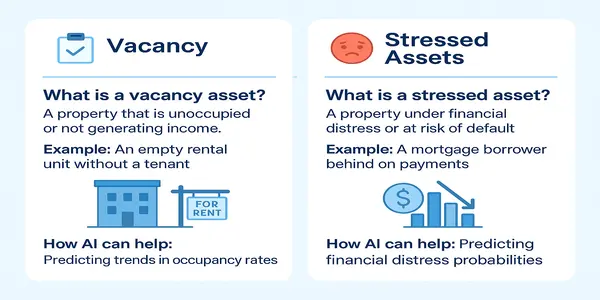
    difference-between-vacancy-and-stressed-asset photo
    Turn questions into insights AI chat for your property made simple.

    1. Vacancy Risk Forecasting

    AI systems analyze footfall patterns, lease churn probabilities, tenant credit data, and market sentiment to forecast which properties may face extended vacancy.

    Benefits include:

    • Proactive tenant retention efforts
    • Pricing adjustments before market shifts
    • Alternative space utilization planning

    2. Stressed Asset Identification

    Some properties decline gradually due to deferred maintenance, tenant dissatisfaction, or neighborhood shifts.

    AI detects these stress signals using:

    • Maintenance logs
    • Delayed rent payments
    • Tenant complaints
    • Nearby business closures

    What appears stable on paper may already be deteriorating beneath the surface.

    3. Demand-Supply Micro-Mapping

    AI enables hyper-local analysis by mapping demand against upcoming supply, construction timelines, and economic indicators. Asset managers gain sharper context for acquisitions or divestment decisions.

    4. Early Lease Termination Signals

    Tenants may signal exit intentions before formally notifying landlords. AI monitors cues like:

    • Reduced space utilization
    • Declining employee headcount
    • Changes in tenant market performance

    This provides early warnings to mitigate downtime and lost revenue.

    The Commercial Investor’s Blind Spot

    AI is indispensable because it sees patterns humans cannot—hundreds of leases, subtle shifts in tenant behavior, and predictive vacancy trends. These insights are measurable, trackable, and actionable, offering a strategic advantage for investors managing complex portfolios.

    Asset Managers: This Is Your Advantage Window

    Currently, only a subset of asset managers use AI-backed analytics to refine their strategies. Early adopters are optimizing performance, de-risking better, allocating smarter, and exiting before markets turn. As AI matures, today’s competitive edge will become tomorrow’s baseline.

    What AI Doesn’t Replace And What It Enhances

    AI amplifies human experience and judgment, allowing asset managers to:

    • Validate assumptions with multi-dimensional data
    • Compare properties beyond surface-level metrics
    • Respond faster to vacancy risks or distressed asset signals
    • Prioritize capital toward high-performing zones or tenants

    For diverse or expanding portfolios, relying only on quarterly reporting or manual review is no longer practical.

    How Trythat.ai Integrates AI for Commercial Real Estate

    Platforms like Trythat.ai go beyond intuitive, chat-based search. By layering AI into property data, it:

    • Cross-checks listings across sources
    • Translates documents for better analysis
    • Maps user preferences for predictive insights

    This creates continuity across the lifecycle from investor dashboards to tenant search journeys.

    Final Thought: Predict, Don’t React

    In commercial real estate, resilience comes from responsiveness, which requires foresight. AI turns noise into signals, and signals into action. Whether evaluating commercial space for rent, managing occupancy trends, or searching for high-performing acquisitions, predictive analytics can be your most valuable ally. In this market, success depends not on seeing vacancies, but on seeing them coming.

  • Faster Closings, Smarter Deals: How Channel Partners Are Winning with AI

    Faster Closings, Smarter Deals: How Channel Partners Are Winning with AI

    For years, AI was treated as a buzzword, something for tech giants and Silicon Valley startups. But not anymore. Today, AI for real estate agents isn’t just real — it’s reshaping the industry. Channel partners who’ve embraced AI aren’t just surviving; they’re closing faster, working smarter, and unlocking more value in every deal.

    The New Advantage: AI for Real Estate Agents

    AI is no longer about future potential — it’s here and it’s a game-changer. From streamlining property listings to identifying serious buyers and predicting market trends, AI tools give channel partners a massive edge. By analyzing customer behavior, automating repetitive tasks, and providing real-time insights, agents spend less time on admin and more time closing deals.

    1. Market Listings in Minutes, Not Hours

    Updating market listings used to be time-consuming. With AI, channel partners can auto-generate compelling listings based on property data, neighborhood trends, and buyer preferences. Some tools even optimize content for SEO, improving visibility and ranking higher in search results.

    The result? Properties spend less time on the market, and channel partners move on to their next deal faster.

    2. AI-Powered Lead Scoring: Know Who’s Ready to Buy

    Tired of chasing cold leads? AI helps real estate agents identify hot prospects by analyzing engagement patterns, buyer behavior, and historical data. It predicts which listings a lead is most likely to act on, so channel partners can focus where it counts.

    Benefits: Fewer dead ends, more meaningful conversations, and smarter deal flow.

    3. Smarter Pricing, Backed by Data

    AI tools provide accurate, real-time property valuation by analyzing similar listings, local demand, seasonality, and historical sales. Instead of relying on gut feel, channel partners can base pricing strategies on verified data.

    This builds trust with clients, reduces negotiation friction, and speeds up closings.

    4. Personalization at Scale

    Clients today expect personalized experiences. AI enables channel partners to automate follow-ups, tailor recommendations based on buyer profiles, and even create custom email flows — all without increasing workload.

    5. Market Intelligence That Works While You Sleep

    AI provides real-time market intelligence, monitoring emerging neighborhood trends, price shifts, and buyer demand. Channel partners receive alerts on areas heating up or listings gaining traction, without manual research.

    It’s not just a time-saver — it’s a deal-maker.

    Practical Applications: Where Channel Partners Are Seeing ROI

    AI for real estate agents is directly impacting outcomes. Key areas of measurable ROI include:

    Smart Market Listing Analysis

    Improves lead quality and reduces time-on-market by identifying listings that resonate with buyers.

    Predictive Lead Scoring

    Helps agents prioritize high-intent leads for faster conversions and higher closing rates.

    Automated Property Alerts

    Keeps buyers engaged with timely, relevant listings, driving retention and deal momentum.

    AI Chat Integration

    Delivers 24/7 responses to buyer queries, capturing more qualified leads. Platforms like Trythat use conversational AI to assist users in discovering relevant properties, making searches smoother and more interactive.

    Virtual Scheduling Assistants

    Automates appointment-setting and calendar coordination, freeing up channel partners for strategic, revenue-generating work.

    These aren’t theoretical benefits — they’re becoming the new standard across forward-looking real estate teams.

    AI Isn’t the Future. It’s Your Competitive Edge Now

    Channel partners who adopt AI are already seeing increased ROI, faster deal turnaround, and stronger client relationships. Whether managing a single property or a large portfolio, AI tools are becoming essential to stay ahead.

    So here’s the real question: Are you still waiting, or are you already winning with AI?

    Explore AI-Driven Real Estate Solutions

    Visit Trythat.AI to see how AI tools are helping channel partners close faster, work smarter, and achieve better deals with verified listings, intelligent insights, and automated workflows.

  • How Can AI Transform Your Real Estate Listing Today?

    How Can AI Transform Your Real Estate Listing Today?

    Technology is transforming how we search for and interact with property information. Specifically, AI in real estate has introduced tools that simplify decision-making and save time for buyers, sellers, and agents. AI-enabled real estate assistants are one of the exciting industry developments. These assistants are designed to handle many of the heavy tasks throughout the real estate process.Whether you want to explore a real estate listing, compare local market data, or verify a property’s credentials, the modern-day AI tools can make the process more efficient and practical.Here’s what these assistants can already do for you, and how Trythat.AI fits into the picture.

    1. Smart Search Across Real Estate Listings

    The traditional real estate search involved browsing through dozens of websites and setting up multiple filters — the process wasn’t the smoothest. AI can now help you navigate real estate listings more efficiently by learning from your preferences and behavior.

    AI assistants can factor in:

    • Prior search patterns
    • Commonly viewed property types
    • Nearby amenities or commute routes
    • User interaction history

    How it Helps: This makes results more contextual and saves time by reducing noise in the discovery process.

    2. Access to Verified Property Listings

    One of the most practical features of AI-driven real estate platforms is the ability to provide verified property listings. These listings are supported by multiple data sources, such as public records, ownership history, or digital documentation, and are flagged accordingly.

    AI tools automate verification by:

    • Checking metadata from listing images
    • Validating data consistency across platforms
    • Comparing ownership information with registry records

    How it Helps: Minimizes misinformation and gives users greater confidence in the authenticity of each property they view.

    3. Real-Time Property Insights

    AI assistants also contribute to data-driven real estate decisions by surfacing relevant insights about each property, beyond just price and area.

    With AI assistants, users can view:

    • Historical pricing trends for the locality
    • Comparison with similar properties nearby
    • Projected rental yields (if applicable)
    • Infrastructure updates or policy changes impacting the area

    How it Helps: These insights are especially valuable for first-time buyers and investors who want to make informed choices without needing expert-level knowledge.

    4. Personalized Recommendations

    AI models go beyond static filters. With access to user data over time, these assistants become more accurate in predicting what you might like and what you’re likely to reject.

    This includes:

    • Suggesting listings as per evolving preferences
    • Re-ranking results based on user feedback
    • Notifying users about price drops or new matches

    How it Helps: The goal isn’t to replace human agents but to reduce the time between discovery and decision by automating repetitive filtering and recommendation tasks.

    5. Support for Sellers and Agents

    AI tools also assist those listing properties by streamlining listing creation, optimization, and visibility.

    Sellers and agents benefit from:

    • Instant listing optimization (suggested titles, tags, or image improvements)
    • Auto-verification prompts
    • Insights into market demand and competition

    How it Helps: Leads to better-prepared listings and increased visibility for the right buyers at the right time.

    6. A Unified Real Estate Experience

    At Trythat.AI, our focus is to bring all these capabilities together on one intuitive platform. We aim to bridge the gap between raw property data and user needs with tools that are relevant, real-time, and highly accurate.

    With our AI-enabled platform, our goal is to help you make smarter real estate decisions.

    Final Thoughts

    One does not have to solely rely on manual searches and fragmented information anymore. With an AI-powered real estate assistant, you can explore a real estate listing, verify details, and understand your options efficiently.

    Trythat.AI is part of this shift toward data-driven real estate experiences  where speed, clarity, and trust are built into the process.

    Ready to make your real estate search seamless?

    Explore how Trythat.AI brings AI, verified data, and seamless discovery together in one platform.