
Author: Rugved J

  • Sellers, Let AI Guide Your Listing Strategy with Market-Backed Suggestions

    Sellers, Let AI Guide Your Listing Strategy with Market-Backed Suggestions

    Selling a property is a big move, and one question always tops every seller’s mind: When is the best time to sell my house? Alongside timing, understanding how to price my house to sell effectively is equally crucial. Price it too high, and your listing risks going stale. Too low, and you could miss out on potential returns.Traditionally, sellers have leaned on real estate agents’ experience or general market trends. But now, AI-enabled tools can assist sellers in making more informed decisions. While they don’t promise perfect timing or valuation, platforms like Trythat.ai offer supportive features, such as access to active listings and similar properties in the market, which help sellers understand how their property might compare within the current landscape.ai-guide-for-listing-strategies-in-online-real-estate-agent-chat -interface-photoBy surfacing recent transactions, similar property pricing, and activity indicators in your area, these tools can help you get a better sense of when and how to list. It’s not a replacement for market expertise, but it’s a practical step toward listing with confidence and better preparation.

    Why Timing Matters in Selling Property

    The real estate market is constantly shifting. Seasonal patterns, interest rate changes, local developments, and changing buyer sentiment all affect how quickly a property sells—and at what price. For sellers, listing at the right time can make a real difference.

    However, identifying the “right moment” is rarely straightforward. What worked one year may not apply the next. This is where AI could play a helpful role. By analyzing large volumes of historical and current data, AI systems might be able to detect patterns and trends that help inform smarter listing decisions over time.

    How AI Could Help Identify Better Timing

    As AI tools continue to develop, they may eventually analyze factors such as:

    • Seasonal transaction patterns and buyer activity
    • Interest rate movements and lending trends
    • Local development announcements or zoning changes
    • Shifts in supply-demand balance within specific micro-markets

    While these systems aren’t perfect or widely available today, their future application could help sellers identify windows of higher buyer interest, not by predicting the future, but by organizing past and present data into useful context. Hence, sellers asking “What is the best time to sell my house?” can receive data-backed suggestions rather than relying on guesswork or outdated reports.

    Pricing Your Property: The Potential of AI in Valuation

    Setting the right price has always involved a mix of experience, intuition, and market knowledge. In the future, AI-driven pricing tools may be able to bring more structure to this process by analyzing:

    • Comparable listings and recent sales
    • Location-specific market conditions
    • Property features and configurations
    • Shifts in inventory and buyer preferences

    Such tools could potentially simulate how price changes affect buyer interest or estimate time-on-market based on current conditions. While not replacements for professional judgment, they may assist sellers in approaching pricing with more clarity and confidence.

    How Trythat.ai Supports Sellers with AI

    Platforms like Trythat.ai are exploring how AI can enhance the selling experience, not by replacing expertise, but by offering additional support through technology. The goal is to simplify key decisions around timing, pricing, and listing visibility.

    • Integrated Ecosystem: Trythat.ai aims to bring together verified listings, buyer-seller interactions, and basic market indicators in one place, helping sellers stay organized.
    • Useful Notifications: Sellers can receive updates about listing performance or changes in activity, which may help them stay aware of market movements.

    Trythat.ai uses AI to support sellers with more context and clarity during their listing journey, not by predicting outcomes, but by organizing verified listings, pricing benchmarks, and market activity signals in one place. This helps sellers make more informed decisions about when and how to list, without relying on guesswork.

    Common Seller Concerns About AI Pricing Tools

    Some sellers worry that AI might oversimplify complex market dynamics or miss the unique characteristics of their property. And those concerns are valid, AI isn’t a replacement for human judgment or local experience. But it may serve as a helpful complement.

    As these tools continue to evolve, smarter AI pricing models could potentially offer:

    • Transparent use of verified data from multiple sources
    • Contextual reasoning behind suggested price ranges
    • Flexibility for agents or sellers to add inputs or override system recommendations

    In the future, this balanced approach might support better-informed pricing conversations between sellers and their agents, not replace them.

    Getting Started: How Sellers Can Use AI Tools Today

    Sellers curious about AI can begin exploring how it fits into their process. While AI pricing and market tools are still maturing, some platforms may offer early-stage features that help contextualize your listing. For example:

    • Generate a rough price benchmark using verified listing comparisons
    • View general market activity or price range patterns in your locality
    • Prepare AI-backed inputs to support conversations with your agent

    It’s not about replacing strategy; it’s about giving sellers more clarity as they work with professionals to list at the right time and price.

    Final Thought: Selling Smarter with AI

    The question “What is the best time to sell my house?” has no one-size-fits-all answer, because every property and market is unique. But AI-powered platforms like Trythat.ai bring unprecedented clarity to this challenge by synthesizing massive data sets into actionable insights.

    By embracing AI property valuation tools and intelligent timing recommendations, sellers can reduce guesswork, price confidently, and attract buyers faster. Whether you’re a first-time seller or a seasoned investor, AI is your new partner for smarter, more successful real estate sales.


  • Ten Real Estate Questions Our AI Tool Can Answer Instantly

    Ten Real Estate Questions Our AI Tool Can Answer Instantly

    How a Real Estate Chatbot Is Becoming the Smartest Property Advisor You’ve Ever Met

    When it comes to finding the right property or the right buyer, speed and clarity matter. Yet, most real estate searches are still stuck in slow, clunky interfaces, endless scrolls, and vague filters. That’s exactly what Trythat.ai set out to fix.

    Our AI tool isn’t just another search bar. It’s a real estate chatbot trained to answer property-related queries in seconds. Think of it as your smartest property advisor, ready 24/7 to guide buyers, sellers, and even casual browsers through the maze of listings, localities, and investment questions.

    Here are ten real estate questions our AI tool can answer instantly, and How it makes the entire journey more action-oriented and intelligent.

    1. “What are the top 2BHK flats in Andheri under ₹1 crore?”

    No need to fumble with filters or scan through irrelevant listings. The chatbot understands context, price sensitivity, location, and even preferred layouts to show hyper-relevant results.

    2. “What questions should I ask before visiting this property?”

    First-time buyers or seasoned channel partners, it’s easy to miss key details. The chatbot gives a tailored checklist based on listing type, location, and buyer intent so you walk in prepared.

    3. “What’s the average rental yield in Whitefield, Bangalore?”

    You won’t find this on a basic property page. But our chatbot pulls insights from live market data to serve investment intelligence on the fly, ideal for buyers, NRIs, or asset managers doing due diligence.

    4. “Is this property RERA approved?”

    Buyers often miss this critical check. With a simple query, our chatbot flags whether a verified property listing is registered with RERA, saving users from later headaches.

    5. “I’m a first-time buyer. What documents will I need?”

    The Trythat chatbot doubles as a knowledge center. From KYC to stamp duty to loan paperwork, it walks users through what’s needed, without jargon and without delay.

    6. “Compare this project with the one in Sector 150.”

    This is where the magic of conversational AI shines. Instead of toggling between tabs and specs, users just ask the chatbot to compare properties, by price, location, builder reputation, amenities, or anything else they care about.

    7. “How does this property compare to similar listings nearby?”

    Instead of manually browsing, the tool displays a comparative snapshot. The pricing, amenities, age, and more, so advisors and buyers can evaluate in minutes, not hours.

    8. “Is this a good time to buy in Noida?”

    Using market sentiment, historical price trends, and micro-location insights, the AI tool provides a reasoned, data-backed answer, turning casual curiosity into decision-ready insight.

    9. “I want a resale flat with no legal issues.”

    Legal risk is a huge concern. Our AI helps buyers ask the right questions and flags listings that are known to be clean and verified, or where caution might be needed.

    10. “Can you show me projects with possession in the next 6 months?”

    Whether someone’s in a hurry or planning a move-in, the chatbot filters results by possession timelines and builder progress. This is especially helpful for investors looking to rent out quickly or end-users with personal deadlines.

    Why This AI Tool Is More Than a Chatbot

    It’s not just about automation, it’s about action. Traditional filters and search boxes only get you so far. Trythat.ai’s real estate chatbot learns, understands, and adapts. It reads buyer intent, understands priorities, and guides them toward better decisions faster.

    • For Buyers: it simplifies the journey
    • For Sellers: it qualifies leads
    • For Developers: it boosts discovery and surfaces high-intent users
    • For Agents: it acts as an assistant that works 24/7

    That’s what makes it a true property advisor, not just a digital form.

    Don’t Just Read Try It Yourself

    You’ve seen what it can do. Now ask your own questions. Visit Trythat.ai and experience how the power of AI makes real estate discovery faster, smarter, and far more human.

    Because in a world flooded with listings, speed and simplicity are the ultimate differentiators, and our AI tool delivers both, instantly.

  • Will AI Replace Property Portals ? What the Data Tells Us About the Future

    Will AI Replace Property Portals ? What the Data Tells Us About the Future

    The real estate industry is shifting from static listings and search filters toward recommendations, verified data, and personalized discovery. This naturally raises a big question: Will AI replace property portals as we know them? It’s an idea worth unpacking, as users demand faster, smarter, and more intuitive tools to find real estate listings. Let’s explore what the data suggests about the future of property portals and whether AI is reshaping the real estate industry for good.

    Are Traditional Portals Outdated?

    Today’s standard property portals are designed to offer searchable databases of properties, basic filters, images, and contact forms. They act as marketplaces connecting sellers, agents, and buyers. However, most still rely on static inputs and manual updates. For users, this often results in:

    • Repetitive browsing
    • Irrelevant listing results
    • Outdated or inaccurate property details
    • A lack of contextual insights

    Most of these platforms provide access but little guidance. And that’s exactly where AI can be an alternative.

    What Makes AI Different from Traditional Property Portals?

    Unlike traditional search engines or portals, AI uses data-driven insights to adapt and learn from user behavior. AI platforms can:

    • Analyze user preferences in real time
    • Compare thousands of listings instantly
    • Offer hyper-personalized suggestions
    • Highlight anomalies or inconsistencies in listing data
    • Forecast market movement using historical data

    This creates an experience that’s far more interactive, accurate, and user-focused. This is something that static portals struggle to deliver at scale.

    The Rise of AI in Real Estate

    AI is already being adopted across several touchpoints in the real estate journey. Examples include:

    • AI chat assistants answering buyer queries
    • Verified listing generation
    • Demand prediction by neighborhood
    • Smart lead scoring on real estate agent portals
    • Dynamic pricing models for rental properties

    Instead of acting like a catalog, AI platforms function more like a personalized advisor. They are filtering out noise and offering relevant insights based on the user’s context.

    Will AI Fully Replace Property Portals?

    Not immediately, and maybe not entirely. But here’s what the future of traditional portals could look like:

    Traditional Portals AI-Enabled Platforms
    Static filters Adaptive search
    Generic listings Personalized recommendations
    Manual verification Automated, multi-source validation
    Minimal insights Data-driven insights at every step
    One-size-fits-all UX Context-aware, mobile-first design

    A Hybrid Future for Real Estate Agent Portals

    Some real estate agent portals are already combining traditional listing structures with AI tools, offering better lead qualification, automated follow-ups, and intelligent dashboards. The result is a modern approach to property tech, where AI enhances the existing systems. Platforms like Trythat.AI represent this shift, merging listing discovery, market data, and smart recommendations under one interface. The end user benefits from both structure and intelligence.

    To Sum Up

    Today, the question isn’t just “Will AI replace property portals?” It’s “Why wouldn’t users want a smarter, faster, more accurate way to find property?” As user expectations change and evolve, portals that stay static may fall behind. AI is transforming how people interact with property data. And that’s the real shift: from listings to intelligence, from options to answers.

    Ready for the next evolution in property search? Explore how Trythat.AI combines verified listings, AI tools, and data-driven insights to deliver the future of real estate.

  • How Can AI Transform Your Real Estate Listing Today?

    How Can AI Transform Your Real Estate Listing Today?

    Technology is transforming how we search for and interact with property information. Specifically, AI in real estate has introduced tools that simplify decision-making and save time for buyers, sellers, and agents. AI-enabled real estate assistants are one of the exciting industry developments. These assistants are designed to handle many of the heavy tasks throughout the real estate process.Whether you want to explore a real estate listing, compare local market data, or verify a property’s credentials, the modern-day AI tools can make the process more efficient and practical.Here’s what these assistants can already do for you, and how Trythat.AI fits into the picture.

    1. Smart Search Across Real Estate Listings

    The traditional real estate search involved browsing through dozens of websites and setting up multiple filters — the process wasn’t the smoothest. AI can now help you navigate real estate listings more efficiently by learning from your preferences and behavior.

    AI assistants can factor in:

    • Prior search patterns
    • Commonly viewed property types
    • Nearby amenities or commute routes
    • User interaction history

    How it Helps: This makes results more contextual and saves time by reducing noise in the discovery process.

    2. Access to Verified Property Listings

    One of the most practical features of AI-driven real estate platforms is the ability to provide verified property listings. These listings are supported by multiple data sources, such as public records, ownership history, or digital documentation, and are flagged accordingly.

    AI tools automate verification by:

    • Checking metadata from listing images
    • Validating data consistency across platforms
    • Comparing ownership information with registry records

    How it Helps: Minimizes misinformation and gives users greater confidence in the authenticity of each property they view.

    3. Real-Time Property Insights

    AI assistants also contribute to data-driven real estate decisions by surfacing relevant insights about each property, beyond just price and area.

    With AI assistants, users can view:

    • Historical pricing trends for the locality
    • Comparison with similar properties nearby
    • Projected rental yields (if applicable)
    • Infrastructure updates or policy changes impacting the area

    How it Helps: These insights are especially valuable for first-time buyers and investors who want to make informed choices without needing expert-level knowledge.

    4. Personalized Recommendations

    AI models go beyond static filters. With access to user data over time, these assistants become more accurate in predicting what you might like and what you’re likely to reject.

    This includes:

    • Suggesting listings as per evolving preferences
    • Re-ranking results based on user feedback
    • Notifying users about price drops or new matches

    How it Helps: The goal isn’t to replace human agents but to reduce the time between discovery and decision by automating repetitive filtering and recommendation tasks.

    5. Support for Sellers and Agents

    AI tools also assist those listing properties by streamlining listing creation, optimization, and visibility.

    Sellers and agents benefit from:

    • Instant listing optimization (suggested titles, tags, or image improvements)
    • Auto-verification prompts
    • Insights into market demand and competition

    How it Helps: Leads to better-prepared listings and increased visibility for the right buyers at the right time.

    6. A Unified Real Estate Experience

    At Trythat.AI, our focus is to bring all these capabilities together on one intuitive platform. We aim to bridge the gap between raw property data and user needs with tools that are relevant, real-time, and highly accurate.

    With our AI-enabled platform, our goal is to help you make smarter real estate decisions.

    Final Thoughts

    One does not have to solely rely on manual searches and fragmented information anymore. With an AI-powered real estate assistant, you can explore a real estate listing, verify details, and understand your options efficiently.

    Trythat.AI is part of this shift toward data-driven real estate experiences  where speed, clarity, and trust are built into the process.

    Ready to make your real estate search seamless?

    Explore how Trythat.AI brings AI, verified data, and seamless discovery together in one platform.

  • Faster Closings, Smarter Deals: How Channel Partners Are Winning with AI

    Faster Closings, Smarter Deals: How Channel Partners Are Winning with AI

    For years, AI was treated as a buzzword, something for tech giants and Silicon Valley startups. But not anymore. Today, AI for real estate agents isn’t just real — it’s reshaping the industry. Channel partners who’ve embraced AI aren’t just surviving; they’re closing faster, working smarter, and unlocking more value in every deal.

    The New Advantage: AI for Real Estate Agents

    AI is no longer about future potential — it’s here and it’s a game-changer. From streamlining property listings to identifying serious buyers and predicting market trends, AI tools give channel partners a massive edge. By analyzing customer behavior, automating repetitive tasks, and providing real-time insights, agents spend less time on admin and more time closing deals.

    1. Market Listings in Minutes, Not Hours

    Updating market listings used to be time-consuming. With AI, channel partners can auto-generate compelling listings based on property data, neighborhood trends, and buyer preferences. Some tools even optimize content for SEO, improving visibility and ranking higher in search results.

    The result? Properties spend less time on the market, and channel partners move on to their next deal faster.

    2. AI-Powered Lead Scoring: Know Who’s Ready to Buy

    Tired of chasing cold leads? AI helps real estate agents identify hot prospects by analyzing engagement patterns, buyer behavior, and historical data. It predicts which listings a lead is most likely to act on, so channel partners can focus where it counts.

    Benefits: Fewer dead ends, more meaningful conversations, and smarter deal flow.

    3. Smarter Pricing, Backed by Data

    AI tools provide accurate, real-time property valuation by analyzing similar listings, local demand, seasonality, and historical sales. Instead of relying on gut feel, channel partners can base pricing strategies on verified data.

    This builds trust with clients, reduces negotiation friction, and speeds up closings.

    4. Personalization at Scale

    Clients today expect personalized experiences. AI enables channel partners to automate follow-ups, tailor recommendations based on buyer profiles, and even create custom email flows — all without increasing workload.

    5. Market Intelligence That Works While You Sleep

    AI provides real-time market intelligence, monitoring emerging neighborhood trends, price shifts, and buyer demand. Channel partners receive alerts on areas heating up or listings gaining traction, without manual research.

    It’s not just a time-saver — it’s a deal-maker.

    Practical Applications: Where Channel Partners Are Seeing ROI

    AI for real estate agents is directly impacting outcomes. Key areas of measurable ROI include:

    Smart Market Listing Analysis

    Improves lead quality and reduces time-on-market by identifying listings that resonate with buyers.

    Predictive Lead Scoring

    Helps agents prioritize high-intent leads for faster conversions and higher closing rates.

    Automated Property Alerts

    Keeps buyers engaged with timely, relevant listings, driving retention and deal momentum.

    AI Chat Integration

    Delivers 24/7 responses to buyer queries, capturing more qualified leads. Platforms like Trythat use conversational AI to assist users in discovering relevant properties, making searches smoother and more interactive.

    Virtual Scheduling Assistants

    Automates appointment-setting and calendar coordination, freeing up channel partners for strategic, revenue-generating work.

    These aren’t theoretical benefits — they’re becoming the new standard across forward-looking real estate teams.

    AI Isn’t the Future. It’s Your Competitive Edge Now

    Channel partners who adopt AI are already seeing increased ROI, faster deal turnaround, and stronger client relationships. Whether managing a single property or a large portfolio, AI tools are becoming essential to stay ahead.

    So here’s the real question: Are you still waiting, or are you already winning with AI?

    Explore AI-Driven Real Estate Solutions

    Visit Trythat.AI to see how AI tools are helping channel partners close faster, work smarter, and achieve better deals with verified listings, intelligent insights, and automated workflows.

  • The Rise of AI-Driven Channel Partners: Adapting to the Future of Real Estate

    The Rise of AI-Driven Channel Partners: Adapting to the Future of Real Estate

    The real estate industry is undergoing a major transformation, driven not by trends but by technology. As client expectations rise and competition intensifies, one truth is clear: AI in real estate is no longer optional. It’s the backbone of the next generation of brokerage, from lead qualification to crafting the perfect real estate listing. Channel partners who recognize this shift and adopt early are best positioned to lead the market.

    AI Is Reshaping Real Estate From the Ground Up

    Real estate is now about data, precision, and timing — not just location. Today, channel partners equipped with smart technology are transforming insights into outcomes. Early adopters are changing how they manage leads, analyze prospects, and close agreements. From sourcing leads to presenting property listings, AI is rewriting the rules. No more gut-based decisions or scattered spreadsheets. Top performers are operating on data-driven real estate strategies that deliver precision, speed, and scale.

    Let’s explore how embracing data-driven real estate tools is redefining professional workflows for verified property listings, property insights, and transaction success.

    1. Verified Property Listings at Scale

    Clients demand accuracy, and channel partners need trust. AI ensures listings are comprehensive and verified across public and proprietary databases. Benefits include:

    • Saves hours of manual cross-checking
    • Strengthens brand credibility
    • Reduces listing errors and misinformation

    2. Richer, Real-Time Property Insights

    Forget static brochures and outdated data. AI-powered analytics can process local demand, pricing history, buyer interest, and neighborhood evolution in real time, delivering actionable insights for both agents and clients.

    3. Smarter Matching, Better Experiences

    By analyzing buyer preferences, behavior, and intent signals, AI tools can match prospects with the listings they’re most likely to act on. This leads to:

    • Less wasted time
    • More deals closed
    • Happier, satisfied clients

    4. Listings That Practically Write Themselves

    Modern AI tools help channel partners generate polished, SEO-optimized listing content in minutes, based on property data, features, and market tone. The result:

    • Faster time-to-market
    • Consistent, high-quality messaging across platforms
    • Better discoverability in search engines

    Adapt or Fall Behind: Why Early Adoption Matters

    Waiting to adopt AI leaves channel partners playing catch-up. Early adopters use:

    • Automation to scale operations
    • Intelligence to improve targeting
    • Insights to refine pitching, listing, and sales

    AI isn’t about replacing agents — it augments them. By handling repetitive tasks, channel partners can focus on building relationships, negotiating deals, and growing their business.

    Real-World Innovation: How Trythat.ai Simplifies Property Search

    AI adoption is already powering real interactions. Trythat.ai uses conversational AI to help users navigate verified property listings in a chat-based experience. Benefits include:

    • Faster, intuitive property discovery
    • More informed and ready-to-convert leads for channel partners
    • Engaging, digital-first experience for buyers

    This represents the next generation of tech-forward, user-centered real estate platforms.

    Future-Ready Channel Partners Are Already Here

    The question is no longer if AI will impact your business, but how soon you’ll let it work for you. Real estate professionals embracing AI now will build smarter operations, stronger pipelines, and more resilient growth.

    In the future of real estate, being human is essential, but being powered by AI is non-negotiable.

    Explore AI-Driven Real Estate Solutions

    Visit Trythat.ai to see how AI tools are helping channel partners close deals faster, work smarter, and achieve more with verified listings, real-time insights, and automated workflows.

  • AI Can Predict Vacancy and Stressed Assets. Are You Listening ?

    AI Can Predict Vacancy and Stressed Assets. Are You Listening ?

    In commercial real estate, timing is everything. A delayed decision can result in missed opportunities, while a wrong call on asset health can lead to extended vacancies or distressed value. In this high-stakes environment, asset managers and commercial investors need more than experience they need precision.That’s where AI in commercial real estate comes in, not just as a support tool, but as a predictive intelligence engine that can spot red flags before they’re visible on a balance sheet or a site visit.

    Why Traditional Methods Are No Longer Enough

    For decades, asset performance was assessed using backward-looking data such as historical lease performance, tenant financials, and occupancy reports. But the market is evolving too fast for these models to keep up. Factors like the rise of hybrid work, shifts in commercial space usage, and macroeconomic uncertainty make it harder to assess asset health in real-time. Gut instinct and static reports can no longer carry the weight of multi-crore investments.

    AI steps in as a predictive intelligence engine, spotting risks before they’re visible on balance sheets or site inspections.

    Insights You Can’t Afford to Miss

    AI doesn’t just automate it illuminates. Here’s how predictive analytics is creating a new tier of visibility for asset managers:

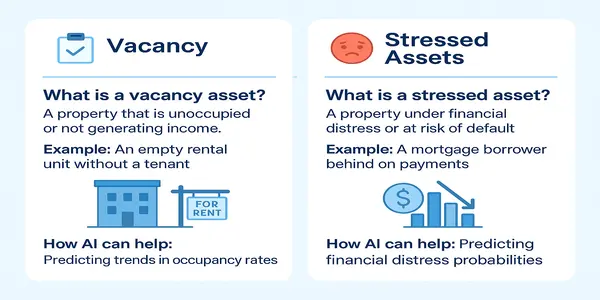
    difference-between-vacancy-and-stressed-asset photo
    Turn questions into insights AI chat for your property made simple.

    1. Vacancy Risk Forecasting

    AI systems analyze footfall patterns, lease churn probabilities, tenant credit data, and market sentiment to forecast which properties may face extended vacancy.

    Benefits include:

    • Proactive tenant retention efforts
    • Pricing adjustments before market shifts
    • Alternative space utilization planning

    2. Stressed Asset Identification

    Some properties decline gradually due to deferred maintenance, tenant dissatisfaction, or neighborhood shifts.

    AI detects these stress signals using:

    • Maintenance logs
    • Delayed rent payments
    • Tenant complaints
    • Nearby business closures

    What appears stable on paper may already be deteriorating beneath the surface.

    3. Demand-Supply Micro-Mapping

    AI enables hyper-local analysis by mapping demand against upcoming supply, construction timelines, and economic indicators. Asset managers gain sharper context for acquisitions or divestment decisions.

    4. Early Lease Termination Signals

    Tenants may signal exit intentions before formally notifying landlords. AI monitors cues like:

    • Reduced space utilization
    • Declining employee headcount
    • Changes in tenant market performance

    This provides early warnings to mitigate downtime and lost revenue.

    The Commercial Investor’s Blind Spot

    AI is indispensable because it sees patterns humans cannot—hundreds of leases, subtle shifts in tenant behavior, and predictive vacancy trends. These insights are measurable, trackable, and actionable, offering a strategic advantage for investors managing complex portfolios.

    Asset Managers: This Is Your Advantage Window

    Currently, only a subset of asset managers use AI-backed analytics to refine their strategies. Early adopters are optimizing performance, de-risking better, allocating smarter, and exiting before markets turn. As AI matures, today’s competitive edge will become tomorrow’s baseline.

    What AI Doesn’t Replace And What It Enhances

    AI amplifies human experience and judgment, allowing asset managers to:

    • Validate assumptions with multi-dimensional data
    • Compare properties beyond surface-level metrics
    • Respond faster to vacancy risks or distressed asset signals
    • Prioritize capital toward high-performing zones or tenants

    For diverse or expanding portfolios, relying only on quarterly reporting or manual review is no longer practical.

    How Trythat.ai Integrates AI for Commercial Real Estate

    Platforms like Trythat.ai go beyond intuitive, chat-based search. By layering AI into property data, it:

    • Cross-checks listings across sources
    • Translates documents for better analysis
    • Maps user preferences for predictive insights

    This creates continuity across the lifecycle from investor dashboards to tenant search journeys.

    Final Thought: Predict, Don’t React

    In commercial real estate, resilience comes from responsiveness, which requires foresight. AI turns noise into signals, and signals into action. Whether evaluating commercial space for rent, managing occupancy trends, or searching for high-performing acquisitions, predictive analytics can be your most valuable ally. In this market, success depends not on seeing vacancies, but on seeing them coming.

  • Why Leading Real Estate Developers Are Using AI to Understand Buyer Behavior

    Why Leading Real Estate Developers Are Using AI to Understand Buyer Behavior

    The modern real estate market is not just about inventory it’s about insights. For leading developers managing large-scale launches and high-stakes investments, understanding buyer behavior has become the key to unlocking smarter sales strategies and faster absorption rates. In a world where choices are abundant and attention spans short, developers can no longer rely on generic buyer personas or outdated feedback cycles. AI is rewriting the playbook for how developers understand and engage with buyers.

    The Shift From Gut Feeling to Buyer Data

    Traditionally, developers and project marketing teams operated with broad assumptions: price-sensitive buyers in Tier 2 cities, luxury preferences in metro hubs, or rising demand for mixed-use spaces post-pandemic. While some of these observations hold true, they often lack precision.

    AI helps close this gap by converting vague trends into actionable insights. From analyzing how buyers interact with listings to tracking location-based demand shifts, AI moves developers from guessing what buyers want to knowing what they’ll choose.

    AI-Powered Insights That Developers Can’t Ignore

    AI is providing tangible value to developers navigating complex markets and diverse buyer pools. Key applications include:

    1. Behavioral Analytics That Reveal True Buyer Intent

    Not all clicks are created equal. AI tools analyze user journeys across platforms to understand:

    • Which properties are clicked most frequently
    • Time spent on specific sections or listings
    • Filter preferences and drop-off points

    These insights help developers position projects more effectively and refine unit configurations before launch.

    2. Demand Forecasting That Guides Smarter Planning

    AI-driven predictive analytics can forecast future demand by analyzing:

    • Past sales data
    • Demographic shifts
    • Mobility and digital trends

    This allows developers to plan better: choosing unit types, amenities, or commercial property allocations that the market will actually absorb.

    3. Micro-Market Trends You Can Act On

    AI identifies hyper-local trends like:

    • Emerging demand corridors
    • Block-level price fluctuations
    • Neighborhood sentiment from search patterns and social signals

    Developers gain an edge in both acquisition and project launch decisions.

    4. Personalization for High-Intent Leads

    AI enables tailored content and communication for individual buyer profiles, such as:

    • Personalized brochures
    • Unit suggestions based on prior interest
    • Targeted nudges for site visits

    Micro-level personalization compounds into significant conversion lifts.

    The Role of AI in Project Marketing

    Project marketing heads can now connect campaign data directly to real buyer behavior. Instead of measuring success purely by leads, teams can evaluate:

    • Lead quality
    • Engagement longevity
    • Conversion probability

    AI also optimizes ad spend by identifying which creatives and messages drive meaningful buyer engagement, boosting ROI across paid and organic channels.

    Developers Need More Than Listings. They Need Understanding

    Traditional online real estate platforms focused on exposure listing inventory and waiting for calls. Today, developers need context, not just clicks. AI provides real-time buyer intelligence through dashboards, behavior visualization, and pricing model suggestions, helping developers act confidently rather than relying on guesswork.

    Platforms like Trythat.ai enhance property discovery using conversational AI, simplifying residential and commercial search experiences. Behind the scenes, AI enables smarter workflows such as comparing listings or translating property documents for regional users.

    AI Is Not Just for Channel Partners and Buyers. It’s for Builders of the Market

    Real estate development balances instinct with strategy, but AI is transforming this equation. Developers leveraging AI gain a decisive edge: understanding current buyer behavior, anticipating future demand, and building projects the market will absorb.

    Final Thought

    Understanding buyer behavior is no longer optional, it’s essential. The developers who thrive won’t rely on the biggest billboards; they’ll be the ones who listen faster, smarter, and more accurately than the rest. With AI, the tools to do this are already available.

  • How AI Simplifies the Property Search Process in 2025 ?

    How AI Simplifies the Property Search Process in 2025 ?

    Searching for a home used to mean browsing multiple platforms, talking to channel partners, dealing with vague listings, and making endless calls just to schedule a viewing. For many, especially first-time buyers, this process was confusing, time-consuming, and often overwhelming. However, artificial intelligence (AI) has transformed that experience, making property search more intuitive and tailored to individual needs.Here’s how AI-powered property search is bringing clarity to the home-buying journey.

    1. AI Understands What You’re Looking For

    Traditional platforms offer basic filters such as price, bedrooms, and location, but they don’t always return the most relevant results. AI adds a layer of understanding by analyzing your:

    • Search behavior
    • Preferences
    • Interaction history

    This allows AI tools to recommend properties that align closely with your needs, reducing irrelevant results and helping you find options faster and with less effort.

    2. Local Property Search That Works

    Finding the right neighborhood can be challenging. AI-powered local property search provides:

    • Average price trends
    • Upcoming developments
    • Nearby schools and amenities

    This context-driven approach eliminates the need for extensive manual research and enables informed location-based decisions.

    3. Clear, Consistent Listing Information

    Inconsistent or incomplete listing information is a major frustration. AI processes and structures large volumes of data to provide:

    • Verified property details
    • Accurate pricing
    • Geo-tagged images
    • Comparable property metrics

    This consistency allows users to compare listings confidently and avoid hidden discrepancies.

    4. AI for First-Time Buyers

    First-time buyers often need guidance on what to look for and how to shortlist properties. AI assists with:

    • Step-by-step guidance
    • Smart suggestions based on buyer profiles
    • Alerts for new listings or price changes
    • Embedded educational tips

    This makes the first home-buying experience less daunting and more manageable.

    5. How Property Search with AI Saves Time

    AI speeds up the property search process by:

    • Automating repetitive filters
    • Accelerating discovery of similar properties
    • Automatically shortlisting based on past behavior
    • Reducing dependency on agents for basic information

    While AI enhances efficiency, it does not replace human interaction; it makes every interaction more informed and productive.

    6. Best Property Finder Tools Use AI

    Leading property finder platforms combine verified data, user behavior, and machine learning to deliver:

    • Accurate search results
    • Personalized property suggestions
    • Real-time insights on availability and pricing
    • Mobile-friendly guided browsing

    At Trythat.AI, AI actively assists users in property discovery, continuously improving recommendations and user experience.

    Final Thoughts

    The property search experience is evolving rapidly. With AI, users can move from endless scrolling and confusion to quick discovery and confidence. Whether you are a first-time buyer or an experienced investor, AI simplifies the process from the very first step.

    Trythat.AIis committed to making AI property search more accessible, reliable, and personalized. We bring together verified listing data, local insights, and smart recommendations, all designed to help you find the right property faster.

    Start your search with clarity.
    Experience how AI can transform your property search. Trythat.AI makes it easier, faster, and smarter.

  • How to Identify a Trusted Real Estate Platform

    How to Identify a Trusted Real Estate Platform

    Buying, selling, or renting a property is one of the most important financial decisions a person makes. Today, the first step for most people is to look online for such real estate-related decisions. Real estate platforms promise thousands of listings, attractive options, and a smoother experience.However, not all real estate platforms are trustworthy. Whether it’s outdated or fake listings or hidden charges, many users experience that a flashy website does not translate to high credibility. If you are just beginning your property search, knowing how to separate a reliable real estate platform from one that may waste your time and money is important.

    This is the guide to help you identify the signs of a trusted real estate platform.

    Verified Listings Are the Foundation of Trust

    Discovering that a listing online doesn’t even exist is one of the biggest frustrations buyers and tenants face. A trustworthy platform makes verified listings its top priority.

    But what does “verified” mean?

    • The property has been checked for accuracy before being published
    • Details like location, size, amenities, and pricing are cross-checked
    • In some instances, the owner or realtors are asked to provide documentation

    A verified listing means no false leads. This saves time and builds confidence that what you see is what you will get.

    Transparent Pricing and Information

    Trustworthy platforms do not hide information. If you find a platform with vague property details or unclear pricing, that is a major red flag.

    A trusted real estate platform should show:

    • Clear pricing with rent structure, deposit, or maintenance fees if applicable
    • Accurate property specifications like square footage, furnishing status, and amenities
    • Photos that actually represent the property, not stock images

    Transparency builds credibility. Without it, you get hidden costs or misleading promises later.

    Strong Compliance and Certifications

    In India, RERA (Real Estate Regulatory Authority) plays a key role in making real estate more transparent. A trustworthy real estate platform will highlight whether the listed properties comply with RERA guidelines.

    Ask yourself:

    • Does the platform emphasize compliance?
    • Does it partner only with brokers or developers who are registered?
    • Are there certifications or industry accreditations visible on the site?

    Platforms that showcase compliance help significantly in protecting you from risks.

    User Reviews and Testimonials

    People trust people. Most of us look at reviews before choosing a restaurant. Real estate is no different.

    A good platform will:

    • Display reviews and ratings from previous users
    • Show both positives and negatives. Too many “perfect” reviews could signal fake ones.
    • Allow you to connect or cross-check references in some cases

    Responsive Customer Support

    Real estate decisions are high-stakes. When you are exploring a platform, test its support system.

    Questions to ask:

    • Do they respond quickly to queries?
    • Can you speak to a human agent, or are you left stuck with generic FAQs?
    • Do they provide guidance beyond just listings (like paperwork or process advice)?

    Good support indicates that the platform is invested in your success, not just in pushing listings.

    Data Security and Privacy

    In the excitement of property hunting, people often overlook this aspect. A trusted platform will take care of how your data is used.

    Check for:

    • Secure website (HTTPS)
    • Clear privacy policies about how your contact details will be used
    • No misuse of your phone number with spam calls after registration

    If a platform respects your privacy, it is most likely to respect your entire real estate journey.

    Tech as a Value-Addition

    The best real estate platforms today do not just act like digital classified ads. They use technology to actually simplify your decision-making.

    Features to look for:

    • Search filters that let you refine results meaningfully, not just by basic price/location
    • AI-powered recommendations that suggest the right properties based on your needs
    • Comparison tools so you can evaluate rent rates, growth potential, or amenities side by side

    Investing in smart tools shows the platform’s commitment to empowering you, not just listing properties.

    Additional Red Flags to Watch Out For

    Sometimes it’s easier to spot what doesn’t look right:

    • Too good to be true prices without explanation
    • Listings with missing addresses or fuzzy details
    • No mention of compliance, verification, or accountability
    • Overly aggressive sales tactics, pushing you to close immediately

    How Trythat Fits In

    At Trythat, we believe that finding your next office or property should be clear, simple, and reliable. That is why we built a platform centered around trust:

    • Every listing is verified before it reaches you
    • The platform emphasizes transparent data, from pricing to compliance checks
    • AI-powered insights help you compare options, check rent rates, or even assess growth potential in just a few clicks
    • And if you need guidance, our support is there to walk you through the process

    As India’s first real estate AI model, Trythat is designed to give you confidence at every step of your real estate journey.

    Summing Up

    Identifying a trusted real estate platform isn’t about flashy ads or endless listings. It’s about verified information, transparency, compliance, user feedback, and technology that empowers you.

    Beyond helping you find a property, the right platform helps you make the biggest property decisions with confidence.

    So, the next time you begin your search, look for these trust signals first. And if you want a head start, Trythat is here to ensure your real estate journey begins on the right note.

    Trythat.ai | Discover Now